
Stop Front Shoulder Pain During Curls and Chin-Ups: 3 Simple Fixes That Actually Work
Does the front of your shoulder light up every time you curl, do chin-ups, or row? You’re not alone. Thousands of dedicated lifters deal with this nagging pain that threatens to derail their training progress. You don’t have to stop training your upper body to fix front shoulder pain. With just 15 minutes of targeted work before your upper body sessions, you can return to pain-free pressing movements like dips and overhead work.
Quick Reference Training Protocol
- Total Time: 15 Minutes
- Targets: Bicep tendon, shoulder blade mechanics, thoracic spine mobility.
- Goals: Pain reduction, improved lifting form, long-term shoulder health.
Exercise 1: Speed’s Test (Bicep Tendon Assessment)

Purpose: Confirm whether your bicep tendon is contributing to your front shoulder pain
Equipment Needed: None
How to Do It
- Stand tall and raise your painful arm straight out in front at shoulder height.
- Place your other hand on your wrist and press straight down as you resist.
- Keep your trunk still—no leaning or twisting.
- Rate any pain from 0-10 for comparison after the corrective exercises.
Sets: 1 assessment test (retest after exercises)
Tip: If this recreates your familiar front shoulder pain, your bicep tendon is definitely part of the problem—but it’s not the whole story.
Exercise 2 – Bench Opener

Purpose: Open up stiff front shoulder and upper back tissues that force your shoulder into compromised positions.
Equipment Needed: Bench or firm surface, optional dowel.
How to Do It
- Kneel in front of a bench and place your elbows on the surface.
- Keep your hands together or hold a dowel between them.
- Slowly sit your hips back and let your chest drop toward the floor.
- Stop before any sharp pain—you should feel a stretch across the front of your shoulders and lats.
Sets: 2 sets of 10-12 reps.
Tip: This drill directly addresses the thoracic spine stiffness that pushes your shoulder blade forward during every curl and chin-up.
Exercise 3: Banded Scap Angels
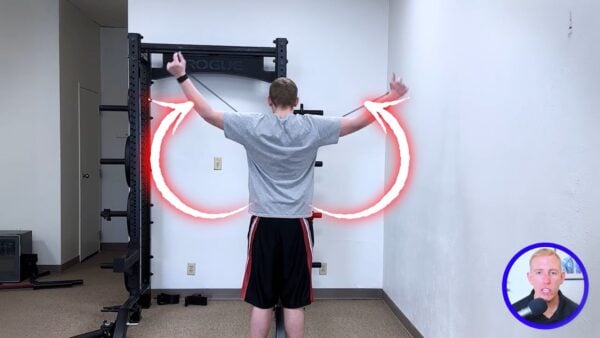
Purpose: To train your shoulder blades to move correctly during pulling movements instead of letting your bicep tendon do all the stabilizing work.
Equipment Needed: Light resistance band, anchor point at chest height.
How to Do It
- Anchor the band at chest height and grab with both hands, arms straight.
- Walk until you feel light tension with your hands in your pockets.
- Keep shoulders gently down and back, then sweep arms up into a “Y” shape like a snow angel.
- Control the movement back down and do not rush.
Sets: 2-3 sets of 8-12 reps
Tip: This exact pattern (shoulders down, blades rotating up) is what you want at the top of curls and throughout chin-ups.
Exercise 4: Chin-Up Eccentrics
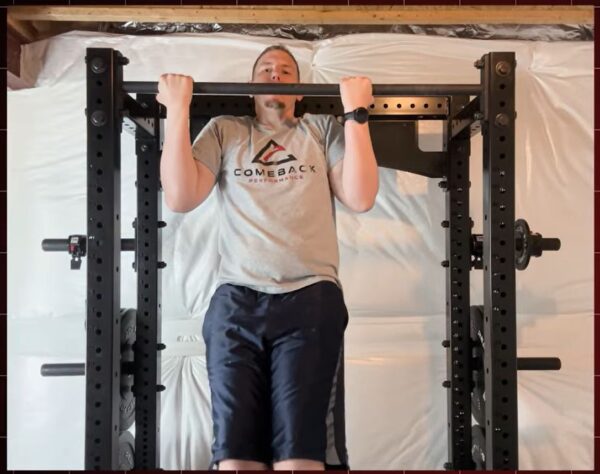
Purpose: Build strength and control through the exact range where your bicep tendon usually gets overloaded.
Equipment Needed: Pull-up bar, box or bench for assistance.
How to Do It
- Use a box or jump to reach the top chin-up position (chin over bar).
- Set your shoulders down and back, then slowly lower yourself over 3-5 seconds.
- Stop just before your absolute dead hang position.
- Step down or use your feet to return to the starting position.
Sets: 2 sets of 3-5 controlled lowers.
Tip: Focus on “shoulders down, then elbows straight”—not the other way around. This builds control where you typically lose it.
Your Next Workout Game Plan
These aren’t just rehab exercises; they’re performance enhancers that make your lifting better while eliminating pain. As already mentioned, this approach addresses the root cause through what Dr. Joey calls the “Big 5” system—your neck, thoracic spine, shoulder blade, shoulder joint, and nerves working as an integrated unit.
One client who couldn’t do dips for years due to shoulder pain reported: “I could finally do dips. I was never able to do dips for years. To be able to do dips where I wasn’t able to do it before tells me I’m moving in the right direction.”
Ready to fix your shoulder pain permanently?
About the Author: Dr. Joey Seyforth


