
Stop Making These 3 Bicep Tendonitis Mistakes That Keep You Out of the Gym After 40
If you’re over 40, train four to five days a week, and every time you bench press or do dips, your front shoulder flares up with sharp, nagging pain – you’re not alone. In fact, this is one of the most common complaints we hear from dedicated lifters who refuse to hang up their lifting belts.
Here’s what most guys tell us: “I used to be able to bench and do dips without any issues. Now, every time I press, my front shoulder blows up, and I’m honestly scared to lift heavy anymore.”
In this blog, you’ll learn the mistakes to avoid and two exercises you can do to correct those mistakes.
Quick Reference Guide
- Total Time: 10 Minutes Daily
- Targets: Shoulder blade, thoracic spine, posterior shoulder, bicep tendon
- Goals: Pain reduction, improved mobility, enhanced shoulder stability
The 3 Devastating Mistakes Keeping You in Pain
Mistake #1: Only Stretching and Mashing the Front of Your Shoulder
The Problem: You feel pain in the front, so you stretch your pec and front delt, mash it with a lacrosse ball, hang off a doorway, and call it “mobility work.” But you’re just yanking on symptoms, not changing the underlying system.
Why It Fails: The areas above and below your shoulder joint remain locked up, and your bicep tendon stays in the same compromised position when you return to lifting.
The Solution: Focus on “Big Five” system activation rather than isolated stretching. Before you press or pull, you need to wake up the back and sides of your shoulder and get your shoulder blades moving properly.
Mistake #2: Hammering Presses with Zero Shoulder Blade Control
The Problem: Over-40 lifters love volume – heavy bench pressing on cold shoulders, endless dips and curls with your shoulder gliding forward every rep, with zero awareness of where the ball of your shoulder is positioned in the socket.
Why It Fails: You end up doing countless sets with the ball riding forward in the socket, forcing your bicep tendon to act as the primary brake for your shoulder on every single rep.
The Solution: Build posterior shoulder strength and teach your shoulders to sit back and down, rather than living in that forward, hunched position. You don’t have to stop benching, you just need to prepare your shoulders properly.
Mistake #3: Ignoring Proper Warm-Up and Load Management
The Problem: This is an epidemic among over-40 lifters. There’s no real warm-up routine and they’re often jumping from zero to heavy bench pressing, random volume spikes (like doing 10 sets of curls after weeks off), then blaming “tendonitis” for every flare-up.
Why It Fails: Your tendon isn’t just angry. It’s completely underprepared for the demands you’re placing on it. You wouldn’t start your car on a cold morning and immediately floor it; your body deserves the same consideration.
The Solution: Implement a structured 5-minute pre-upper body routine and practice honest volume management. Stop jumping from no training to heavy lifting three times per week.
Two Game-Changing Exercises to Fix Your Shoulders
Exercise 1: Banded Scapular Angels
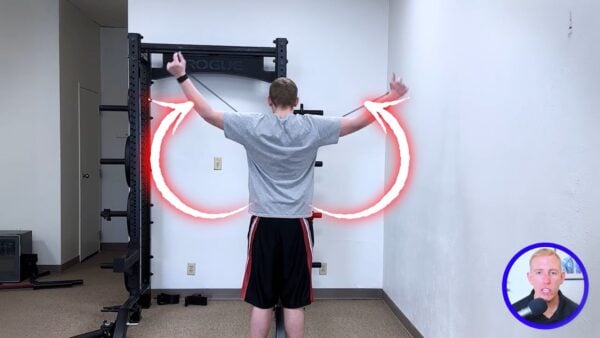
Purpose: Wake up your shoulder blade movement and create proper joint spacing instead of just stretching the front.
Equipment Needed: Light resistance band and anchor point.
How to Do It
- Anchor a light band in front of you at chest level while you grab it with both hands, arms straight.
- Walk back to create light tension, then bring your hands toward your hips with straight elbows to set your shoulders down and back.
- Slowly move your arms out into an “angel” position, ending with the biceps near the ears if comfortable.
- Return down with control, focusing on the shoulder blades rotating back, not just arm movement.
Sets: 2-3 sets of 8-12 reps as part of upper body warm-up
Tip: Keep your ribs down and avoid arching your lower back to fake the range of motion.
Exercise 2: Banded Extension + External Rotation

Purpose: Teach your shoulder to sit back and down instead of forward and jammed – critical for bicep tendonitis prevention.
Equipment Needed: Light resistance band
How to Do It:
- Place a light band around your wrists behind your back, starting with your arms straight and your hands near your hips.
- Pull the band apart slightly to create external rotation torque.
- While maintaining that tension, move your shoulders slightly back into extension.
- Return to start with control, feeling the work in the back of the shoulders, not the neck.
Sets: 2-3 sets of 8-10 reps before bench or push days
Tip: Keep shoulders away from ears – no shrugging allowed. Focus on the back of your shoulders doing the work.
Don’t Let Bicep Tendonitis Stop You!
The reality is this: if you’re over 40 with bicep tendonitis, it’s usually not that you’re too old to lift heavy. The problem is you’re only addressing symptoms rather than the system, hammering through exercises without proper shoulder control, and ignoring the warm-up and load management your body desperately needs.
Remember, the goal isn’t perfect MRI results – it’s being able to do the exercises you love without your shoulder barking at you every rep. Talk to a professional about your shoulder health now!
About the Author: Dr. Joey Seyforth


