
The One Exercise That Fixes Front Shoulder Pain During Bench Press (For Men 40-65)
Most guys are told that bench pressing is “bad for your shoulders.” But here’s the truth: it’s not the bench press that’s the problem—it’s how your shoulder is sitting and moving in that position. The good news is that you don’t have to give up benching forever.
Poor shoulder blade control affects your shoulder joint positioning, which compromises your rotator cuff function, which then leads to that sharp, stabbing pain that makes you fear every rep. In this blog, you’ll learn one simple 2-minute exercise you can do before every bench session that targets the exact mechanical dysfunction causing your pain.
Quick Reference Box
Total Time: 2 Minutes
Targets: Shoulder blade mechanics, shoulder joint positioning, extension mobility
Goals: Pain reduction, proper joint positioning, injury prevention.
Quick Self-Assessment: The Shoulder Extension Test
How to Test Your Extension
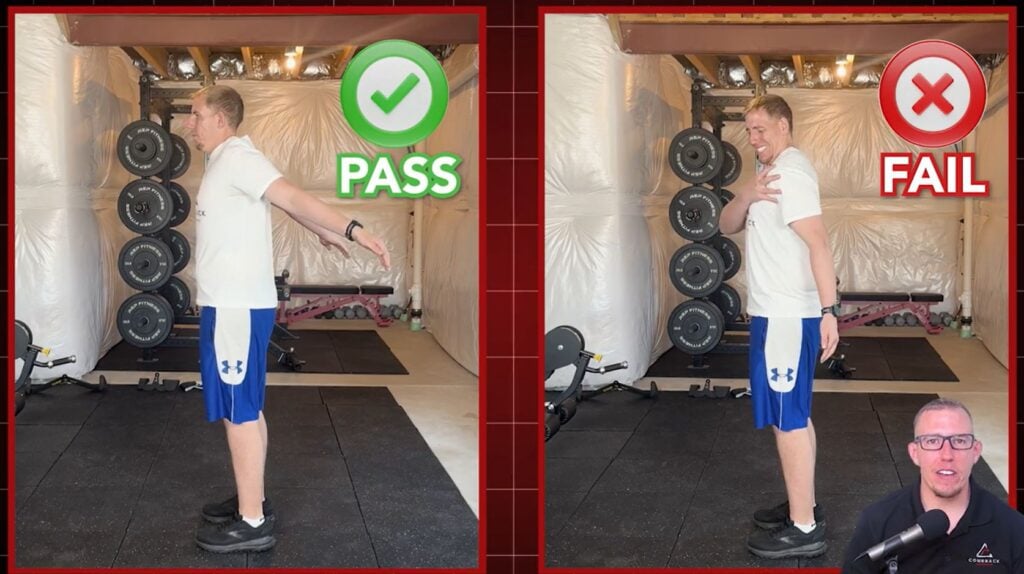
Purpose: Determine if the lack of shoulder extension is contributing to your bench press pain
Equipment Needed: None
How to Do It
- Stand tall with your arms relaxed by your sides.
- Keep your chest up without arching your lower back.
- Lift your hands straight back behind you as far as comfortable.
- Check if you can get your hands roughly a forearm’s width away from your back.
Assessment: If you can’t achieve this distance without front shoulder discomfort, you’re missing the extension that bench pressing demands.
The Solution: Banded Posterior Shoulder Mobilization
Exercise: Banded Posterior Shoulder Mobilization
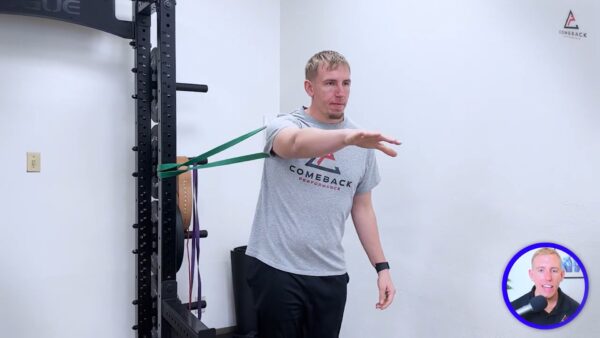
Purpose: Reset shoulder joint positioning and restore proper extension before bench pressing
Equipment Needed: Resistance band and anchor point at chest height
How to Do It
- Anchor the band at the chest to shoulder height behind you.
- Face away from the anchor and loop the band around the front of your painful shoulder.
- Step forward until you feel the band gently pulling your shoulder backward into the socket.
- Set your bench press stance: slight arch, shoulder blades tucked, ribs down.
- Perform a slow, controlled bench press motion with the banded arm.
- Let your arm move out and down like the bottom of a bench press.
- Press back up to the starting position.
Sets: 3 sets of 12 reps on the painful side.
Key Points
- Keep the motion slow and controlled—this is a rehearsal, not a heavy lift.
- The band should constantly pull the ball of your shoulder back and slightly down.
- You should feel a gentle stretch in the front of your shoulder, not sharp pain.
- If you experience sharp pain, reduce the range of motion.
Tip: Think of this exercise as “resetting the joint before you load it.” You’re teaching your shoulder the proper path it needs during the bench press.
Before Every Bench Session
- Perform the shoulder extension test to assess how you’re feeling that day.
- Complete 3 sets of 12 banded posterior shoulder mobilizations on your painful side.
- Proceed with your regular barbell warm-ups and working sets.
Expected Timeline for Results
- Immediate – Better joint positioning for that session.
- Week 1-2 – Reduced front shoulder bite at the bottom position.
- Week 3-4 – More solid feeling under the bar and increased confidence.
- Long-term – Elimination of fear that one wrong rep will send your shoulder “over the edge.”
Bonus tip: If you’re particularly stiff, perform this exercise daily, not just on bench days, for accelerated results.
Take Action Now!
This 2-minute exercise addresses the root mechanical dysfunction, not just the symptoms. Unlike passive treatments that only provide temporary relief, this approach gives you the tools to solve the problem actively. For complete resolution of chronic shoulder pain, consider working with a specialist who understands the interconnected nature of shoulder mechanics.
About the Author: Dr. Joey Seyforth


