
Why Your Traditional Rhomboid Pain Treatments Are Failing (And 3 Exercises That Work)
If you’ve been dealing with that nagging pain and tightness between your shoulder blades—constantly massaging it, stretching it, only to have it return within hours or days—you’re not alone. Here’s the frustrating reality: what you think is a rhomboid problem might not be a rhomboid problem at all. The reason your traditional treatments keep failing isn’t that you’re not doing them correctly. It’s because you’re treating the symptom rather than the cause.
Why This Pain Extends Beyond Your Shoulder Blades
The rhomboid pain you’re experiencing is a result of a complex chain reaction. It’s caused by compressed or irritated nerves. The nerves that control your rhomboids originate in your neck, around the C5 to C7 vertebrae. When its compressed or irritated by poor posture or repetitive activities, they send pain signals to the rhomboid area.
Your rhomboids respond by going into protection mode—tightening up and creating that familiar knot or spasm you feel between your shoulder blades. They’re not the problem; they’re trying to protect you from what they perceive as a threat.
The Chain Reaction That’s Keeping You In Pain
Think of it like a smoke alarm going off in your house. You can disconnect the alarm (massage the rhomboids), but if you don’t put out the fire (address the nerve irritation in your neck), the alarm will keep going off. This is exactly why
- Massage provides only temporary relief
- Stretching fails to create lasting change
- The pain keeps returning, sometimes even worse than before
Good news: With just 10 minutes a day, you can break this cycle and address the real source of your pain.
Quick Reference: Your Rhomboid Relief Protocol
Total Time: 10 Minutes
Targets: Cervical spine, thoracic spine, rhomboids, posterior shoulder blade muscles
Goals: Nerve decompression, mobility restoration, strength building
Exercise Breakdown: The 3-Step Solution
Exercise 1: Chin Retraction (Nerve Decompression)

Purpose: To decompress the cervical nerve roots that are sending pain signals to your rhomboids.
Equipment Needed: None.
How to Do It
- Sit up tall with your feet flat on the ground.
- Gently tuck your chin back to create a “double chin” position.
- Hold for 2 seconds, feeling a gentle stretch at the base of your skull.
- Return to the starting position and repeat.
Sets: 2 sets of 10 repetitions.
Tip: Don’t force the movement or drop your head—think about creating a double chin while maintaining your upright posture. You should feel the stretch extending down your neck and into your upper back.
Exercise 2: Bench Opener (Thoracic Mobility)

Purpose: Restores thoracic extension and opens up the space between your shoulder blades where the rhomboids attach.
Equipment Needed: Bench or chair, PVC pipe or broomstick.
How to Do It
- Kneel in front of a bench and grab your implement with palms facing up.
- Place your elbows on the bench, then lower your hips.
- Press your chest forward toward the ground (not just your head).
- Hold for 2-3 seconds, feeling the stretch in your mid-back and lats.
Sets: 2 sets of 8 repetitions.
Tip: Keep your palms facing up throughout the movement and work within your comfortable range. You should feel it in your mid-back, not your lower back. Stop before you feel pain.
Exercise 3: Banded Scapular Angel (Strength & Coordination)
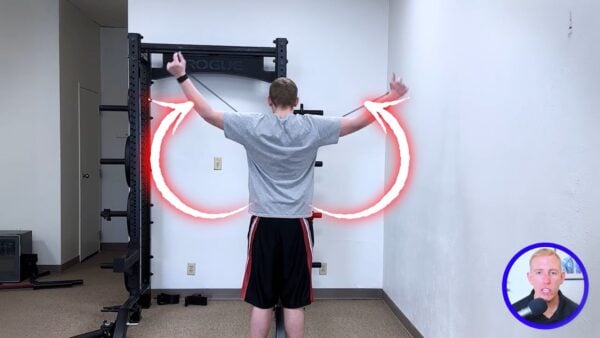
Purpose: Builds shoulder blade strength and coordination to prevent the rhomboids from returning to protection mode.
Equipment Needed: Resistance band anchored in front of you.
How to Do It
- Pull the band back with your elbows, starting in a retracted position.
- Move into an “angel” motion by extending your arms to the sides.
- End with your biceps by your ears, focusing on posterior tilt and external rotation.
- Return to the starting position with control.
Sets: 2 sets of 8 repetitions.
Tip: Focus on controlling shoulder blade movement throughout the full range of motion. You should feel this working in your mid-back and rear shoulders, rather than in your neck or lower back.
Why These Exercises Succeed Where Others Fail
These three exercises are effective because they address the root cause of the problem, not just the symptoms.
- Chin retractions decompress the nerve roots, causing the referred pain.
- Bench openers restore the thoracic mobility needed for proper shoulder blade function.
- Banded scapular angels build the strength and coordination to keep everything working properly.
Unlike massage or stretching, this protocol addresses nerve irritation, restores proper movement patterns, and builds strength to prevent recurrence.
Your Path to Lasting Relief
You should perform this 10-minute routine daily for the best results. If you’re serious about eliminating your shoulder pain for good and want a tailored, step-by-step approach, consider working with a movement specialist who can address your specific contributing factors and create a comprehensive recovery plan.
About the Author: Dr. Joey Seyforth


