
Shoulder Pain When Reaching Overhead? Here’s the 4-Exercise Fix That Works in Minutes
Are you constantly modifying your workouts because reaching overhead triggers sharp shoulder pain? Do simple daily tasks like putting on a shirt or reaching for something on a high shelf make you wince? You’re not alone – thousands of people struggle with this exact issue, and it’s preventing them from living their lives to the fullest. In this blog, we talk about exercises for tackling shoulder pain when lifting your arms.
The four areas that directly impact your shoulder’s ability to reach overhead are
- Your neck (cervical spine mobility)
- Your upper back (thoracic spine rotation)
- Your shoulder blade (scapular movement)
- Your shoulder joint (glenohumeral mobility)
Think of it like wearing a tight shirt – you can still lift your arms, but it’s much more difficult and uncomfortable. When these areas are restricted, your shoulder blade can’t rotate properly as you reach up, literally running out of space and causing that painful pinch. The solution doesn’t require expensive equipment, hours of therapy, or complex movements.
With just 10-15 minutes a day, you can
- Eliminate that painful pinching sensation when reaching overhead.
- Restore the full range of motion for daily activities.
- Return to your favorite gym exercises without modification.
- Improve posture and reduce upper body tension.
- Prevent future shoulder injuries.
- Feel confident putting on shirts, throwing balls, or lifting weights overhead.
Quick Reference Guide
- Total Time: 10-15 Minutes
- Targets: Posterior shoulder capsule, overhead mobility, shoulder blade movement, thoracic spine rotation
- Goals: Pain reduction, increased mobility, restored overhead function
The 4-Exercise Solution for Overhead Shoulder Pain
Exercise 1: Ball Posterior Capsule Mobilization
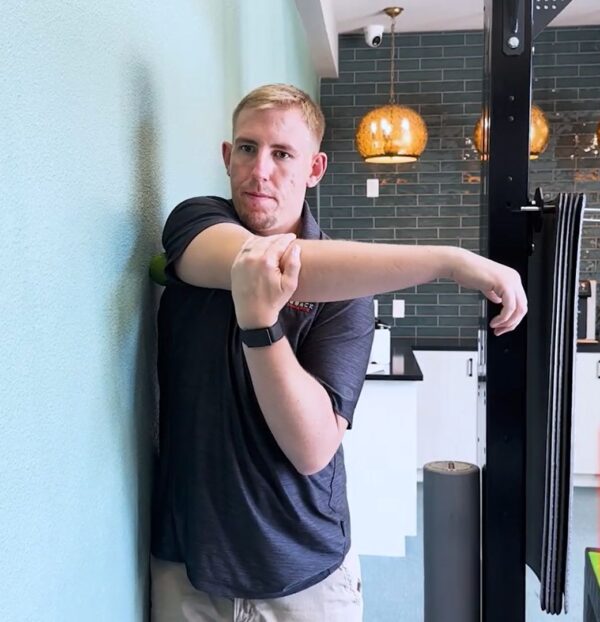
Purpose: Releases tightness in the back of your shoulder that prevents proper overhead movement.
Equipment Needed: Lacrosse ball and wall.
How to Do It
- Place the lacrosse ball between your shoulder blade and the wall.
- Pull your affected arm across your chest (like the classic baseball stretch).
- Keep your shoulder blade pinned against the ball – don’t let it move with your arm.
- Hold the stretch briefly, then return to the starting position.
Sets: 12 reps on each side.
Tip: You should feel a stretch in the back and side of your shoulder. If you experience pain (not just stretching), back off the intensity and don’t force the movement.
Exercise 2: Dowel Abduction

Purpose: Safely guides your shoulder into better overhead positioning while building tolerance to the movement.
Equipment Needed: Dowel, PVC pipe, or broomstick.
How to Do It
- Hold the dowel with your affected hand at one end.
- Use your other arm to lift the dowel (and your affected arm) out to the side.
- Raise until you feel a gentle stretch, then lower back down.
- If it’s too painful, modify by moving your arm at a 45-degree angle instead of straight out.
Sets: 15 reps.
Tip: Let your good arm do the work – this exercise is about gentle, controlled movement, not forcing through pain. Progress gradually as the motion feels better.
Exercise 3: Wall Slides

Purpose: Frees up your shoulder blade so that it moves freely, and it eliminates the anterior pinching sensation.
Equipment Needed: None (just a wall).
How to Do It
- Stand at arm’s length from a wall with one foot slightly in front of the other.
- Place your hands on the wall with forearms off the wall.
- Slide your arms and hands up the wall while leaning your chest forward.
- Focus on feeling your shoulder blades move up and around.
Sets: 15 reps (can be repeated every 2 hours throughout the day).
Tip: This is especially effective first thing in the morning when you’re feeling stiff. The key is the forward lean, which activates proper shoulder blade movement patterns.
Exercise 4: Thoracic Rotations
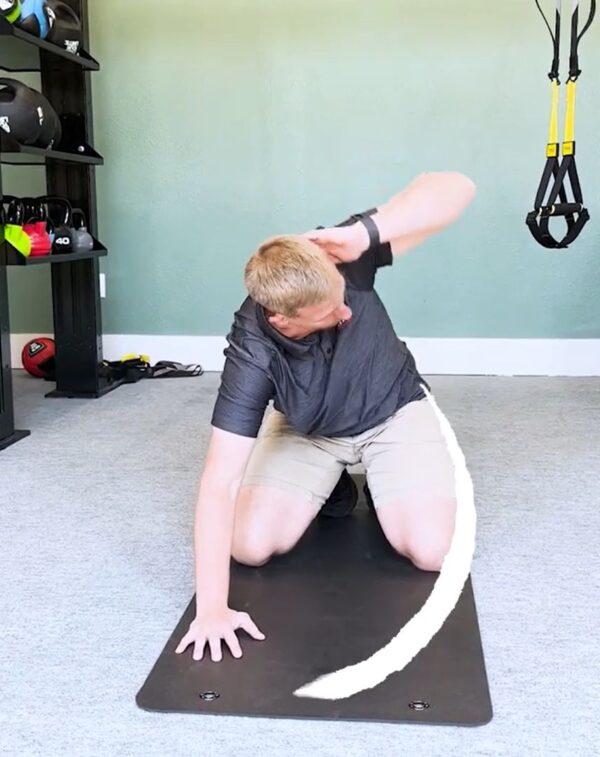
Purpose: Unlocks the upper back and neck regions that directly impact shoulder function.
Equipment Needed: None.
How to Do It
- Start in a tabletop position on hands and knees.
- Rock your hips back toward your heels to engage your lower back muscles.
- Place one hand behind your head and reach that elbow toward the opposite elbow.
- Then rotate up and out as far as comfortable, opening up through your upper back.
Sets: 12 reps on each side.
Tip: Compare how far you can rotate on each side – differences often explain why one shoulder hurts more than the other. Focus on the rotation coming from your upper back, not forcing the movement.
Test Your Progress Immediately
After completing all four exercises, lift your arms overhead and check for any difference. If you experience
- Less pain – These exercises address your specific restrictions.
- More mobility – You’re on the right track for long-term improvement.
- More effortless movement – Your body is responding to the targeted approach.
Even minor improvements indicate that these movements are checking the right boxes for your recovery.
Your Starting Point
While these exercises provide excellent initial relief and can significantly improve your overhead movement, they’re designed as a starting point. For complete, long-term resolution of your shoulder pain, a thorough assessment is needed to identify the root cause of your specific restrictions and tightness patterns.
About the Author: Dr. Joey Seyforth


