
Top 3 Shoulder Pain Relief Exercises You’re Not Doing (But Should)
Are you stretching, strengthening, and icing your shoulder, but the nagging pain just won’t quit? If your answer is yes, then today’s your lucky day, because this guide will show you three exercises for shoulder pain that won’t go away.
It’s a frustrating cycle that keeps you from lifting, playing your favorite sports, or even getting a good night’s sleep. If you’ve focused all your efforts on the shoulder joint itself, you might be missing the real source of the problem.
The good news is that the fix might be simpler than you think.
Your shoulder doesn’t work in isolation. It’s part of a complex chain of movement involving your neck, thoracic spine (mid-back), shoulder blade (scapula), and a web of nerves. When one part of this chain doesn’t move correctly—like a “stuck” shoulder blade or a compressed nerve path—the shoulder joint is forced to pick up the slack. This compensation is what leads to popping, grinding, impingement, and chronic pain.
This article will show you how to break that cycle. We’ll introduce three specific exercises that target the root cause of your discomfort. By investing just a few minutes a day, you can start to feel real relief and get back to moving freely.
With just 5-7 minutes a day, you can
- Find immediate relief from nagging pain, stiffness, and clicking.
- Finally sleep through the night without pain waking you up.
- Improve your shoulder mobility and regain your full range of motion.
- Address the underlying cause of impingement and nerve tension.
- Get back to the activities you love, like golf, pickleball, and lifting overhead.
- Build a foundation for long-term shoulder health, helping you avoid injections or surgery.
Quick Reference Guide
- Total Time: 5–7 Minutes
- Targets: Shoulder Blade (Scapula), First Rib, Thoracic Spine, Shoulder Joint Capsule
- Goals: Reduce pain and nerve tension, improve shoulder blade mobility, and increase rotational control.
Your 3-Move Routine for Shoulder Relief
The following three exercises were designed to free up restrictions above, below, and at the shoulder joint, allowing your body to move smoothly and without pain.
It’s important to move in a pain-free range of motion. None of these exercises should cause sharp or shooting pain. Therefore, if you experience any of those, stop doing the exercises and possibly see a professional.
Exercise #1: Belt First Rib Mobilization

Purpose: This movement releases an elevated first rib, a common and overlooked issue that can compress nerves, cause impingement, and lead to pain while sleeping.
Equipment Needed: A belt, dog leash, or sturdy strap.
How to Do It
- While seated, loop the belt over your upper trapezius muscle (between your neck and shoulder) on the painful side. Hold the end of the belt with your hand on the same side to maintain gentle downward tension.
- Slowly turn your head to look down and in toward that side’s armpit.
- From that position, reverse the movement by looking up and away toward the opposite side.
Sets: 1-2 sets of 20 repetitions.
Tip: Perform this exercise 10 minutes before bed. Releasing tension around the first rib can dramatically reduce pain and pressure when you lie on your side, leading to much better sleep.
Exercise #2: Wall Slides

Purpose: Wall slides are one of the best ways to retrain proper shoulder blade (scapular) movement, which is essential for healthy overhead motion.
Equipment Needed: A wall.
How to Do It
- Stand facing a wall with one foot staggered in front of the other. Place your forearms on the wall with your hands at about shoulder height.
- Slowly begin sliding your arms up the wall.
- As your arms move upward, gently lean your chest forward toward the wall. Focus on feeling your shoulder blades rotate up and wrap around your ribcage.
Sets: 3 sets of 10 repetitions.
Tip: Avoid shrugging your shoulders up toward your ears. Keep your neck and traps relaxed, and make sure the movement is driven by your shoulder blades, not by arching your lower back.
Exercise #3: Banded Axial Rotations
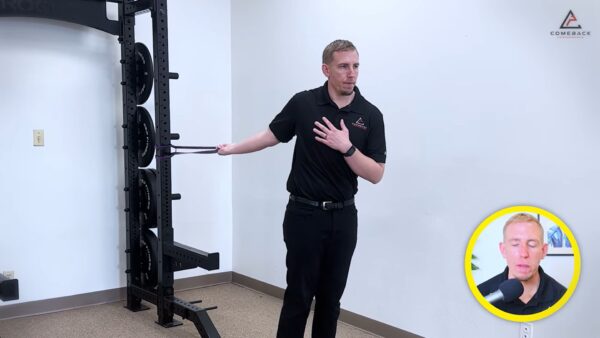
Purpose: This exercise uses a resistance band to gently pull the shoulder joint open (distraction), creating space while you work on improving its crucial rotational capacity.
Equipment Needed: A light resistance band and a stable anchor point (like a door frame or squat rack).
How to Do It
- Anchor the band at about waist height. Stand in front of the anchor and hold the band with your arm straight behind you. The band should be pulling your arm directly backwards.
- Keeping your elbow straight, slowly rotate your shoulder internally (turning your thumb down toward the floor).
- Then, slowly rotate it externally (turning your thumb up toward the ceiling). Keep the movement smooth and controlled.
Sets: 2 sets of 45-60 seconds.
Tip: This is a game-changer for anyone dealing with stiffness or clicking. The band’s gentle pull creates room in the joint capsule, allowing for smoother, pain-free rotation.
Beyond the Exercises: Your Path to Permanent Relief
Consistency is the key to lasting change. Performing these movements daily helps remap your body’s movement patterns and reinforces healthy mechanics. You should start feeling immediate benefits, like less pain and better sleep, just by incorporating this short routine.
However, remember that these exercises are a starting point. True, permanent healing comes from identifying your specific root cause and progressing through a strategic mobility and strengthening plan tailored to you.
If you’re tired of the frustrating cycle of physical therapy, chiropractic, injections, and other temporary fixes that haven’t delivered long-term results, it may be time for a more targeted approach. Our mission at Comeback Performance is to help people eliminate shoulder pain for good and get their lives back.
Ready to take the next step?
About the Author: Dr. Joey Seyforth


