
Fix Shoulder Impingement for Good: 4 Exercises That Target the Root Cause
That stabbing pain you feel when you raise your arm to 60 and 120 degrees of arm elevation is known as shoulder impingement, and it affects millions of active adults who’ve already tried everything from cortisone shots to physical therapy with little lasting relief. Shoulder impingement is a symptom, not a cause. Think of your shoulder pain like a domino effect. When your mid-back becomes stiff from years of desk work and poor posture, it locks your shoulder blade in place.
The good news? This systematic breakdown requires a systematic solution, which we’ve outlined below.
Quick Reference: Your Shoulder Fix Protocol
- Total Time: 15 Minutes
- Targets: Thoracic spine, shoulder blade mechanics, rotator cuff strength
- Goals: Restore mobility, eliminate impingement, build lasting strength
Test First: Confirm Your Impingement Pattern
Before starting the exercises, let’s confirm what we’re dealing with using two simple tests:
Test 1: Hawkins-Kennedy Impingement Test
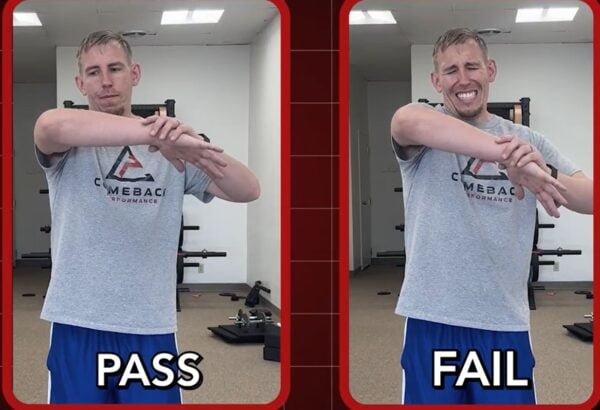
- Bring your arm forward at shoulder height with your elbow bent at 90°, like making an “L” in front of you.
- Use your other hand to gently push your forearm down, internally rotating your shoulder while keeping your elbow at 90°.
- If this recreates a pinch or ache inside your shoulder, you’ve confirmed impingement.
Test 2: Neer Impingement Test
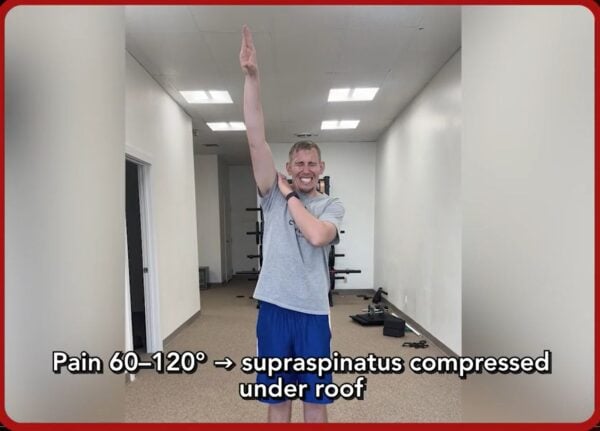
- Stand tall and take your affected arm with your thumb pointing down.
- Use your other arm to assist and lift it overhead.
- If you feel pain at the top of this arc, especially between 60 and 120°, that’s your supraspinatus getting compressed in the subacromial space – your impingement zone.
Remember these test results – we’ll retest after the exercises to see exactly what’s changed.
Exercise 1: Bench Opener for Thoracic Spine Extension

Purpose: To unlock your mid-back to free up space for proper shoulder blade rotation.
Equipment Needed: Bench or chair, broomstick or PVC pipe
How to Do It
- Kneel in front of a bench or chair and hold a broomstick with palms facing up, elbows resting on the bench.
- Drop your hips back towards your heels while pressing your chest towards the floor.
- Hold for 2-3 seconds at end range, feeling the stretch in your upper back and lat muscles.
- Return to your start position.
Sets: 2 sets of 8-10 reps
Tip: You should feel this in two places – your upper back between the shoulder blades and your lat muscles.
Exercise 2: Wall Slide + Lift Off for Shoulder Blade Training

Purpose: To retrain your shoulder blades to rotate properly and “lift the roof” of your shoulder joint.
Equipment Needed: Wall space
How to Do It
- Stand facing a wall with hands in a goalpost position, elbows at 90°.
- Slowly slide both arms overhead while maintaining wall contact.
- At the top position, squeeze shoulder blades down and back, then actively lift hands off the wall.
- Lower with control, keeping the movement slow and deliberate.
Sets: 2 sets of 10 reps
Tip: Avoid shrugging your shoulders toward your ears. The movement should come from shoulder blade rotation, not shoulder elevation.
Exercise 3: Banded W Hold for Rotator Cuff Strength

Purpose: Strengthen your rotator cuff to pull the ball of your shoulder down and back in the socket
Equipment Needed: Light resistance band
How to Do It
- Hold both ends of a light band with elbows at your sides at 90° (W position).
- Create tension by externally rotating your shoulders with palms facing up.
- Squeeze shoulder blades down and together while holding for 5 seconds.
- Return slowly while maintaining tension throughout.
Sets: 2 sets of 8 reps with 5-second holds
Tip: Keep your elbows at the same height throughout the entire exercise. The moment they drop, you lose the rotator cuff loading position that makes this exercise effective.
Exercise 4: Banded Scaption for Integration
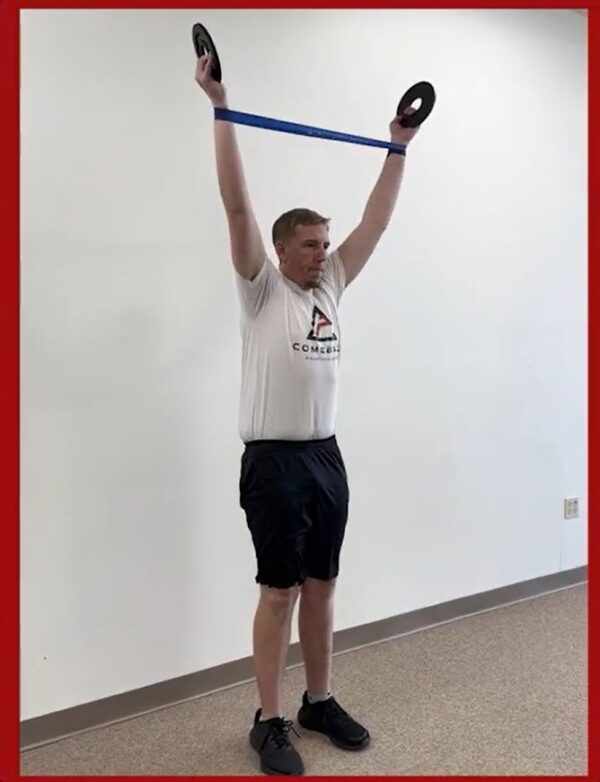
Purpose: Train your supraspinatus in its strongest, safest range while reinforcing proper movement patterns
Equipment Needed: Resistance band
How to Do It
- Wrap the band around your wrists and press outward to create tension.
- Raise both arms diagonally forward about 30° from your sides (scapular plane).
- Keep thumbs pointed up and control the movement both up and down.
- Focus on the quality of movement over speed.
Sets: 2 sets of 10 reps
Tip: This will feel different from a standard lateral raise.
Now go back to your two initial tests:
For most people, even after a single round of these exercises, there’s a noticeable shift. The catch becomes less sharp, the arc opens up, and some people find the pinch completely gone.
Your Path to Permanent Relief
These four exercises provide a strong foundation, but lasting relief requires consistency and often personalization. Practice this routine daily for 2-3 weeks and track your progress using the two tests.
While these exercises address the most common impingement patterns, everyone’s shoulder mechanics are unique. If you’re tired of feeling stuck and want a long term solution with a personalized approach built around your specific movement limitations and lifestyle factors, book a consultation.
About the Author: Dr. Joey Seyforth


