
Stop Night Shoulder Pain: 4 Exercises for Better Sleep Tonight
If shoulder pain wakes you up at night no matter what position you try, no matter how many pillows you stack, you’re not alone. This isn’t just disrupting your sleep, it’s your body sending you a critical message that most people miss entirely. Night shoulder pain isn’t random, and it’s not permanent. The real problem extends far beyond where you feel the pain.
However, with just 10 minutes and four targeted exercises, you can address these root causes and finally get the sleep you deserve.
Quick Reference Guide
- Total Time: 10 Minutes.
- Targets: Posterior shoulder capsule, thoracic spine, shoulder blade mechanics, and joint decompression.
- Goals: Immediate pain reduction, improved joint mobility, long-term sleep quality.
Before starting the exercises, perform these two simple tests to identify your specific pain pattern
Test 1: Cross-Body Horizontal Adduction Test
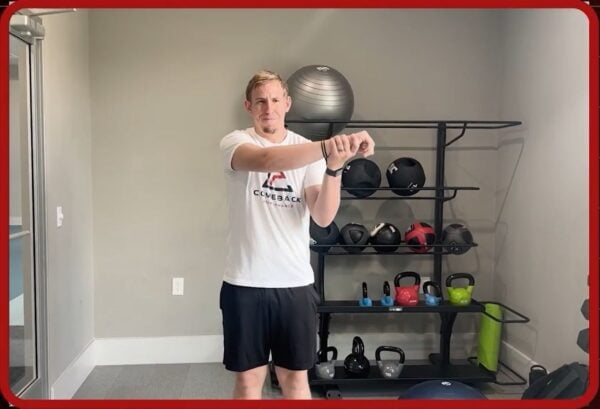
Purpose: Identifies posterior shoulder capsule tightness contributing to night pain
Equipment Needed: None
How to Do It:
- Stand up and bring your affected arm forward to shoulder height (90°)
- Use your opposite hand to pull your elbow across your body gently
- Note any deep ache, pinch, or tightness in the back of your shoulder
Positive Sign: Pain or tightness when the elbow crosses midline
Tip: This is a normal finding for night shoulder pain sufferers—it confirms we’re targeting the right area
Test 2: The Clearing Test
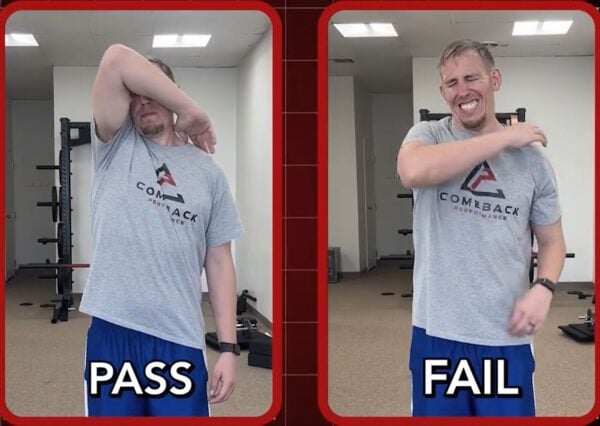
Purpose: Identifies front-of-shoulder impingement patterns
Equipment Needed: None
How to Do It:
- Place your hand on your opposite shoulder
- Slowly lift your elbow upward toward the ceiling
- Note any pain in the front of your shoulder
Positive Sign: Pain in the anterior (front) shoulder during elevation
Tip: A positive test indicates compression that worsens when lying down
The 4-Exercise Night Pain Solution
Exercise 1 – Ball Posterior Capsule Mobilization
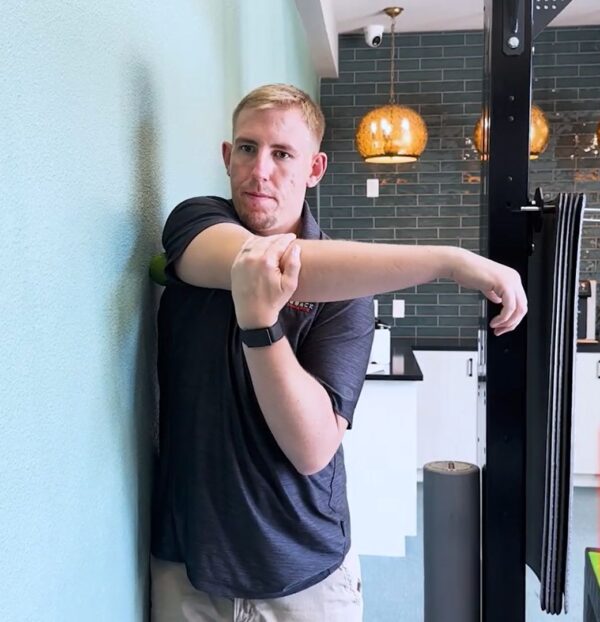
Purpose – To directly releases the tight posterior capsule, causing forward shoulder migration.
Equipment Needed: Tennis ball or lacrosse ball.
How to Do It
- Stand facing a wall with the ball placed on the back of your shoulder, just below the shoulder blade’s bony tip
- Lean gently into the wall, creating pressure through the ball
- Bring your arm across your body using your opposite hand as a guide
- Feel the stretch in your posterior shoulder as the capsule releases
Sets: 15 repetitions per side
Tip: Avoid placing the ball too high on the trap muscle—find the sweet spot between your shoulder blade and the wall
Exercise 2: Sidelying Open Book

Purpose – To restore thoracic spine rotation to create space for proper shoulder movement.
Equipment Needed: None
How to Do It:
- Lie on your side with knees bent 90° and stacked, arms straight forward at shoulder height
- Slowly rotate your top arm up and back toward the floor behind you
- Let your eyes and head follow your hand while keeping your hips stacked
- Hold for 2 seconds at the end range before returning to the start
Sets: 2 sets of 10 repetitions each side
Tip: Keep your knees together—if your hips rotate, you’re cheating with your lower back instead of mobilizing your T-spine
Exercise 3: Wall Slides with Lift-Off

Purpose: Trains proper shoulder blade upward rotation to prevent impingement
Equipment Needed: Wall
How to Do It:
- Stand 6 inches from a wall with hands placed in a “goalpost” position
- Slowly slide your arms up the wall while maintaining hand contact
- At the top, perform a “lift-off” by pulling shoulder blades down and back
- Control the movement back down without arching your lower back
Sets: 2 sets of 10 repetitions
Tip: Think “shoulders low, neck long” to avoid shrugging—the movement should feel like your shoulder blades rotating around your ribcage
Exercise 4: Banded Posterior Shoulder Mobilization
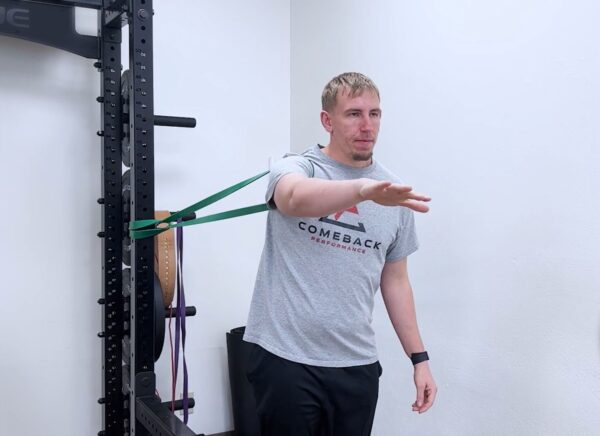
Purpose – To create joint space decompression in the exact direction compressed during side-sleeping.
Equipment Needed – Resistance band.
How to Do It
- Attach the band at shoulder height and face away from the anchor point.
- Place the band around the front of your shoulder near the armpit.
- Step forward to create gentle tension with the band pulling your shoulder back.
- Perform slow chest press motions while the band maintains traction.
Sets: 1 set of 15-20 repetitions
Tip: The band should gently pull your shoulder back—don’t create so much tension that you’re fighting against it
Get Pain-Free Sleep
The key to getting lasting results from doing this exercise is consistency. These exercises work because they target the mechanical problems causing your pain, not just the symptoms. It’s necessary to point out that everyone’s night pain pattern is unique. Consider working with a shoulder specialist who understands these mechanical relationships if you want a personalized approach that addresses your specific movement limitations.
About the Author: Dr. Joey Seyforth


