
How to Fix Rounded Shoulders After 40: The 5-Minute “Big Five” Reset That Actually Works
If you’re over 40 and cringe every time you see yourself in gym photos—shoulders rolled forward, head jutting out like a question mark—you’re not alone. That hunched posture isn’t just affecting how you look; it’s sabotaging your bench press, overhead work, and even making you uncomfortable at your desk all day.
You’ve tried the usual chest stretches, “sitting up straight,” maybe even some foam rolling. And sure, it works… for about 5 minutes. Then you’re right back in that familiar slouch, wondering why nothing seems to stick.
There’s a solution.
With just 5 minutes a day, you can
- Restore proper alignment throughout your entire upper body chain.
- Improve overhead mobility for better pressing and pulling.
- Reduce neck and upper back tension from desk work.
- Enhance your bench press setup and shoulder stability.
- Feel more confident and comfortable in your own skin.
- Train your nervous system to maintain better positions long-term.
Quick Reference Box
- Total Time – 5 Minutes
- Targets – Neck, thoracic spine, shoulder blades, shoulder joints, postural muscles
- Goals – Restore mobility, build stability, retrain movement patterns
The Complete 5-Minute Big Five Reset
Assessment: Test Your Current Mobility
Before jumping into the exercises, let’s see where you stand with two quick self-assessments:
Wall Angel Test
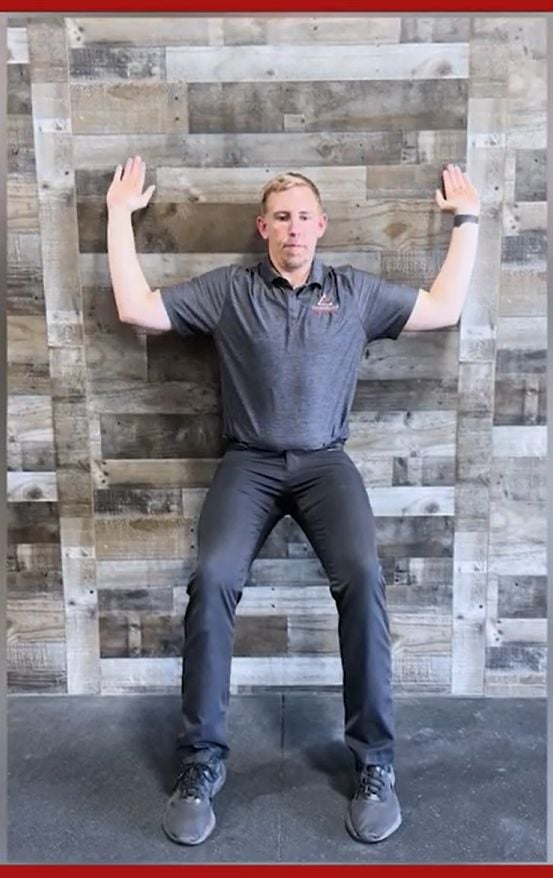
- Stand with your back against a wall, feet a few inches forward
- Gently press your hips and upper back against the wall
- Bring your arms up like a goalpost position
- Try to touch your hands to the wall without arching your lower back
What it reveals: If you can’t get your hands near the wall or have to arch your back significantly, your neck, mid-back, and shoulder blades are pulling you into that rounded position.
Shoulder Flexion Check
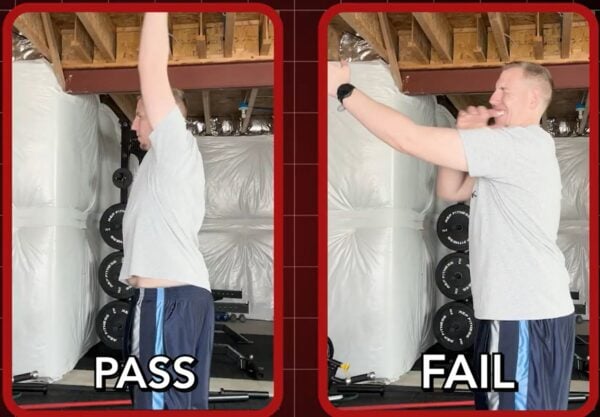
- Stand tall with good posture
- Slowly raise both arms out in front and overhead
- Watch for rib flare, lower back arch, or inability to get your arms fully overhead
What it reveals: If your body has to “cheat” with spinal movement to get overhead, rounded shoulders are affecting more than just your chest muscles.
Exercise 1: Chin Tuck + Extension

Purpose – Retrains your neck to stack properly over your shoulders instead of hanging out in front
Equipment Needed – None
How to Do It
- Sit or stand tall with good alignment.
- Gently glide your head straight back, like making a double chin (don’t force it).
- From the tucked position, slowly move your head into gentle extension.
- Return to neutral and relax completely.
Sets: 10 slow, controlled repetitions.
Tip: Focus on the gliding motion rather than forcing your head back—this teaches proper cervical mechanics without strain.
Exercise 2: Bench Opener

Purpose: Opens up your thoracic spine and front shoulders to break the rounded, collapsed position
Equipment Needed: Bench, sturdy chair, or couch
How to Do It:
- Kneel in front of a bench or chair
- Place your elbows on the surface with your hands together (or holding a dowel)
- Slowly sit your hips back and let your chest drop between your arms
- Feel the stretch through your lats, front shoulders, and mid-back movement
Sets: 8-10 smooth repetitions
Tip: Focus on the movement through your mid-back rather than just stretching—you’re teaching your spine to extend properly.
Exercise 3: Banded Scap Angels
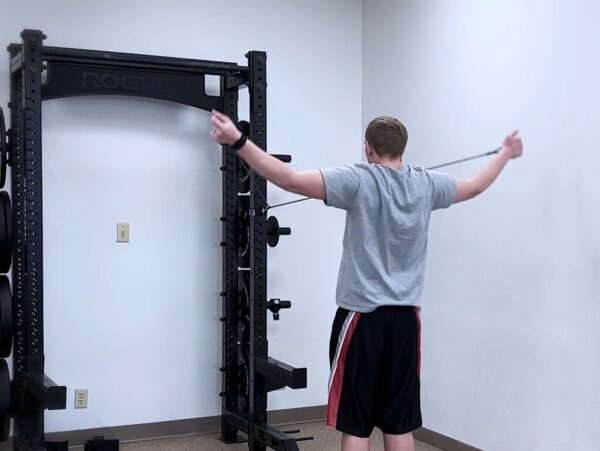
Purpose: Trains your shoulder blades and shoulders to move into a more open, upright position
Equipment Needed: Light resistance band
How to Do It:
- Anchor a light band at chest height
- Hold with both hands, arms straight out in front
- Step back to create light tension
- Slowly sweep your arms up overhead in a wide arc, letting shoulder blades rotate up and around your ribs
Sets: 10 controlled repetitions
Tip: You should feel muscles around your shoulder blades working, not a sharp pinch—this builds strength in the correct movement pattern.
Exercise 4: Banded Extension + External Rotation

Purpose: Strengthens the posterior shoulder muscles to counteract the forward rounded position
Equipment Needed: Light resistance band
How to Do It
- Hold a light band with both hands behind your back
- Start with your hands near your lower back
- Gently pull the band apart and back, bringing the shoulders into slight extension
- Think “opening your chest” and “tucking shoulder blades into back pockets”
Sets: 10 controlled repetitions
Tip: You should feel this in the back of your shoulders and upper back, not the front—avoid letting the band snap back and control the return.
Exercise 5: Bear Shoulder Taps
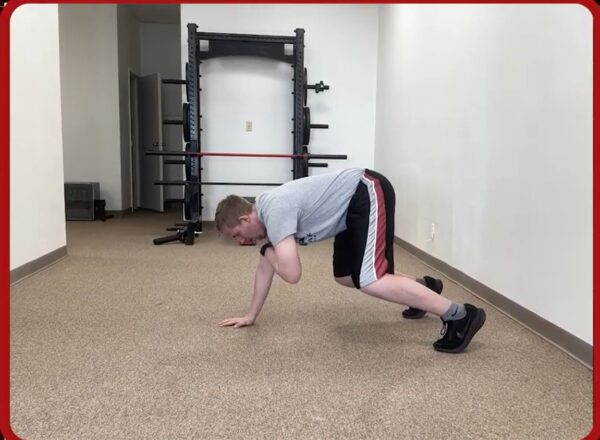
Purpose – To build closed-chain stability and reinforces better positioning under load.
Equipment Needed: None
How to Do It
- Get into bear crawl position: hands under shoulders, knees under hips
- Lift your knees 1-2 inches off the ground.
- Slowly tap your opposite shoulder with one hand
- Switch sides while keeping hips as steady as possible
Sets: 2 sets of 20-30 seconds
Tip: This exercise teaches your shoulders to maintain good position while loaded—exactly what they need during training.
When to Use This Reset
During Long Desk Days: Run through once at midday and once before shutting your laptop
Before Upper Body Training: Complete the full sequence before bench press, push-ups, overhead press, or shoulder-heavy sessions
On Rest Days: Perform once daily to prevent your body from defaulting back to slouched positions
Your Next Steps
Remember, your shoulders exist within the “Big Five” system. Over 40, the goal isn’t perfect posture 24/7—it’s having strong, stable, and smart shoulders that let you live and lift on your own terms. While this reset will provide immediate relief and improved function, addressing rounded shoulders completely often requires a personalized approach that identifies your specific weak links and movement compensations.
About the Author: Dr. Joey Seyforth


