
Frozen Shoulder Fix: 5 Essential Exercises for Rapid Recovery
Many people who’ve had the frozen shoulder experience will tell you that it feels like their shoulder is locked in concrete. If you’re struggling with frozen shoulder, you know exactly what I’m talking about. That gnawing ache that never seems to go away, the inability to reach for something on a high shelf, or the sharp pain that shoots through your arm when you try to put on a shirt. Frozen shoulder steals your independence; however, you can get it back with these frozen shoulder exercises at home.
Let’s have a quick look at what frozen shoulder is.
Frozen shoulder is also medically known as adhesive capsulitis. It creates a domino effect throughout your entire body. When your shoulder capsule becomes inflamed and bound, it doesn’t just affect your arm movement. Your neck compensates with awkward positioning, your back muscles work overtime to help with daily tasks, and your quality of life plummets as simple activities become monumental challenges.
The most devastating part? Many people feel completely helpless, unsure of what they can do to break free from this cycle of pain and restriction. They avoid movement altogether, which only makes the problem worse.
You don’t have to accept this as your new normal. You can unlock your shoulders now and be free from the discomfort by doing these exercises that take about 15 minutes daily. It will
- Dramatically improve your range of motion in the two most restricted movements (reaching overhead and rotating outward).
- Reduce daily pain levels that have been limiting your activities and affecting your sleep.
- Regain independence in basic tasks like dressing, reaching, and lifting.
- Prevent further deterioration of shoulder mobility and strength.
- Break the compensation patterns that are creating tension in your neck and back.
- Restore confidence in your body’s ability to move without fear of sharp pain.
Quick Reference Guide
- Total Time: 15-20 Minutes.
- Targets: Shoulder capsule, rotator cuff muscles, and shoulder blade mobility.
- Goals: Restore abduction (lifting arm to side), improve external rotation, and reduce inflammation.
Exercise 1: Dowel Abduction

Purpose: Safely restore your ability to lift your arm out to the side without forcing painful movement.
Equipment Needed: PVC pipe, broomstick, golf club, or baseball bat.
How to Do It
- Place the end of your dowel in the open palm of your affected arm.
- Use your unaffected arm to grip the dowel and gently push your affected shoulder into abduction (lifting out to the side).
- If full abduction is too painful, start at a 45-degree angle to offload the shoulder.
- Move only within your comfortable range—never force the motion.
Sets: 3 sets of 15 repetitions.
Tip: This exercise should feel like a gentle stretch, not a battle. If you’re grimacing through the movement, you’re pushing too hard and may actually increase inflammation.
Exercise 2: Dowel External Rotation
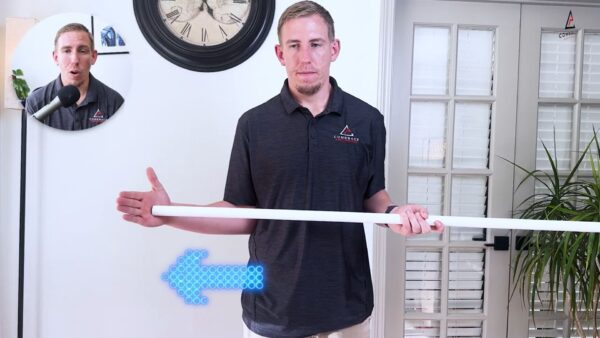
Purpose: Gradually restore the throwing motion that’s typically the most restricted and slowest to return after frozen shoulder.
Equipment Needed: PVC pipe, broomstick, golf club, or baseball bat.
How to Do It
- Hold the dowel with your affected hand at one end, keeping your elbow tucked at your side.
- Use your unaffected arm to grip the dowel and guide the movement.
- Slowly rotate your affected arm outward (like the motion of throwing a baseball).
- Focus on controlled movement rather than range; this motion takes the longest to improve.
Sets: 3 sets of 15 repetitions.
Tip: Don’t be discouraged if you barely move at first. External rotation is the most stubborn movement to return, and even tiny improvements are significant victories.
Exercise 3: Dowel Extension
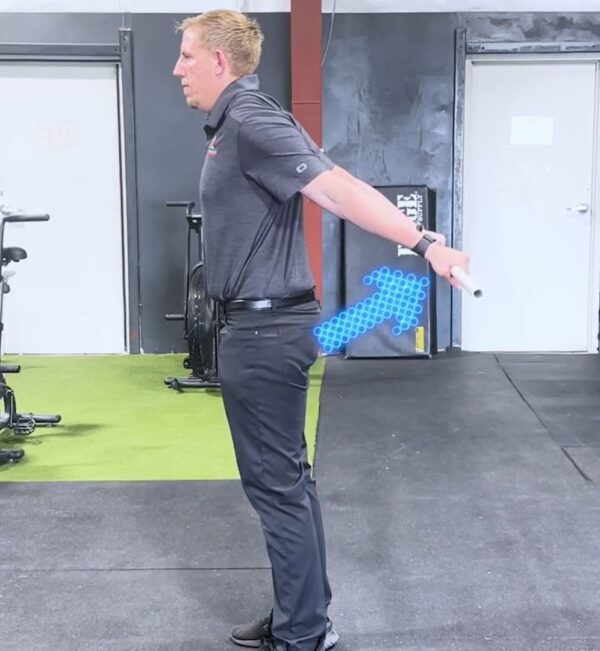
Purpose: Unlock the backward movement of your shoulder while engaging both sides for balanced mobility.
Equipment Needed: PVC pipe, broomstick, golf club, or baseball bat.
How to Do It
- Hold the dowel behind your back with both hands.
- Keep your shoulders and elbows as straight as possible.
- Lift your arms straight back, using your unaffected side to guide the movement.
- Hold the end position for 2-3 seconds, breathing into the stretch.
Sets: 3 sets of 15 repetitions.
Tip: The movement should come from your shoulders, not your spine.
Exercise 4: Sidelying Open Book
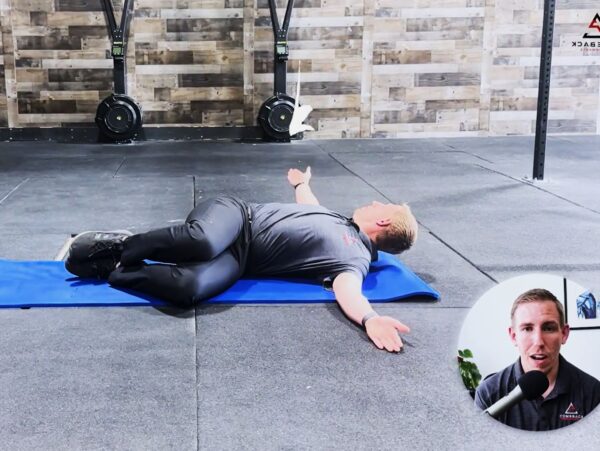
Purpose: Improve rotational mobility while integrating your neck and spine for whole-body movement coordination.
Equipment Needed: None (can be done on bed or floor).
How to Do It
- Lie on your side with your knees tucked up, starting with both hands together.
- Open your top hand and rotate away from the leg that’s down, keeping your hips connected to the ground.
- Follow your moving hand with your eyes to integrate neck movement.
- Rotate as far as comfortable, then return to the starting position.
Sets: 2 sets of 12 on each side.
Tip: You’ll likely notice one side is much more restricted than the other. This is completely normal with frozen shoulder and will improve with consistent practice.
Exercise 5: Wall Slide

Purpose: Restore overhead reaching ability while improving shoulder blade movement and reducing compensatory patterns.
Equipment Needed: Wall (furniture slider optional for easier progression).
How to Do It
- Place your affected hand flat against a wall.
- Slide your hand up the wall while leaning your chest forward.
- If the wall creates too much resistance, place a furniture slider under your hand for easier gliding.
- Focus on feeling your shoulder blade move as you slide upward.
Sets: 4 sets of 10 repetitions.
Tip: The magic happens in your shoulder blade movement. As you slide up, you should feel the muscles around your shoulder blade working—this is exactly what we want to restore proper shoulder mechanics.
Declare War On Frozen Shoulders!
Ready to break free from frozen shoulder for good? If your answer is yes, then you need consistency – it’s your secret weapon against frozen shoulder. These five exercises, will begin breaking down the adhesions and inflammation that have held your shoulder captive. While these movements can provide substantial relief and restore basic function, frozen shoulder recovery often requires a comprehensive approach that addresses the root cause of your condition.
About the Author: Dr. Joey Seyforth


