
Fix Your Infraspinatus: The Hidden Cause of Shoulder Pain You’re Ignoring
What if the reason your shoulder pain won’t go away has nothing to do with where it actually hurts? What if the real problem is a muscle you’ve probably never heard of that’s getting weaker every day you ignore it? If you’re experiencing shoulder pain, weakness during pressing movements, or feeling unstable when overhead, this could be the missing piece you’ve been searching for. You’ll find some proven infraspinatus exercises for front shoulder pain in this blog.
Before we get into the exercises, see the problem!
The Problem That’s Been Hiding in Plain Sight
Your shoulder hurts in the front. You feel weak during the bench press. Overhead movements feel shaky and unstable. You’ve tried ice, rest, anti-inflammatory medications, and possibly even physical therapy with basic band exercises. But the pain keeps coming back because you’re treating the symptom, not the cause. The real culprit? Your infraspinatus – one of your four rotator cuff muscles that’s responsible for external rotation and shoulder stabilization.
It’s Not Just About Your Shoulder
When you experience shoulder pain, your nervous system automatically reduces the strength of muscles like the infraspinatus as a protective mechanism. Think of it like your hand on a hot stove – your brain immediately reduces muscle activity to protect you from further damage. This creates a devastating cycle where your infraspinatus gets progressively weaker while you focus on treating the pain in the front of your shoulder.
The Domino Effect Destroying Your Shoulder
As your infraspinatus weakens, the muscles in the front of your shoulder have to work overtime to compensate. This overloads the front of the shoulder, creating more pain, which further inhibits your infraspinatus. Meanwhile, if your neck, thoracic spine, and shoulder blade aren’t moving correctly, your infraspinatus has to work even harder to maintain stability, leading to earlier fatigue and eventual breakdown.
The Solution You’ve Been Missing
Today, you’ll learn five specific exercises that don’t just strengthen your infraspinatus, but train it to function in all the positions where you actually need it.
With this targeted infraspinatus training, you can
- Eliminate front shoulder pain by restoring proper muscle balance and joint stability.
- Feel significantly stronger and more stable during pressing movements, such as the bench press.
- Regain confidence with overhead activities without that shaky, unstable feeling.
- Break the vicious cycle of compensation that keeps your shoulder problems coming back.
- Improve your shoulder’s ability to handle unexpected forces during sports and daily activities.
- Build true functional strength that translates to real-world movements, not just isolated exercises.
Quick Reference Guide
- Total Time: 15-20 Minutes.
- Targets: Infraspinatus, posterior rotator cuff, and shoulder stabilizers.
- Goals: Shoulder stability, pain reduction, functional strength in multiple planes.
Safety Note: Work within pain-free ranges. If you experience sharp pain, numbness, or worsening symptoms, stop immediately and consult a healthcare professional.
Exercise Breakdown
Exercise 1: Banded Extension + External Rotation

Purpose: Trains your infraspinatus to work while your arm is in extension – a position most people never train but need constantly throughout the day.
Equipment Needed: Resistance band
How to Do It
- Place a band around both wrists and bring your arms behind your back with palms facing away.
- Create tension by pulling the band apart while moving your shoulders into extension.
- Hold for 1-2 seconds, focusing on the back of your shoulder, working.
- Return to the starting position with control.
Sets: 2-3 sets of 10-12 reps.
Tip: You should feel this working the back of your shoulder in a position you’ve probably never trained before. If you feel it in your neck or front shoulder, reduce the range of motion.
Exercise 2: Banded Bench ER Lift-Off
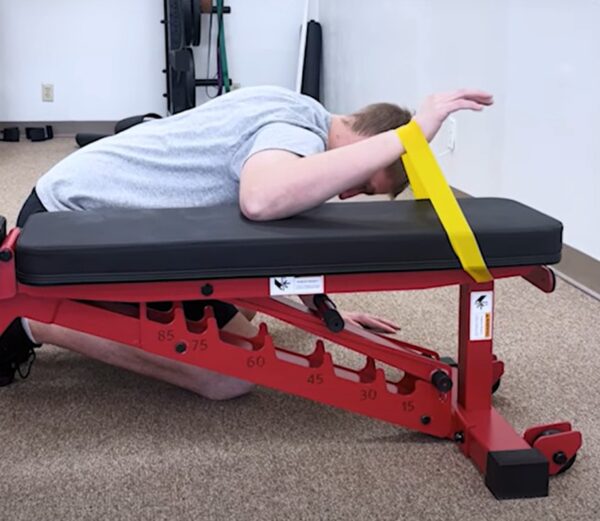
Purpose: Addresses the exact position where most people feel weak and unstable – at 90° of shoulder flexion during pressing movements.
Equipment Needed: A bench or elevated surface and a circular resistance band.
How to Do It
- Lie face down with your working arm on a bench, elbow bent to 90°, with a band around your wrist pulling down toward the bench.
- Keeping your elbow planted on the bench, lift your hand and forearm off the bench into external rotation.
- Hold for 2-3 seconds, feeling the burn in the back of your shoulder.
- Lower with control back to the starting position.
Sets: 2-3 sets of 6-8 reps per side.
Tip: This trains your infraspinatus to provide stability during the exact movement pattern where most people experience weakness and pain. Keep your shoulder blades pulled back and down throughout the movement.
Exercise 3: Row + ER + Press
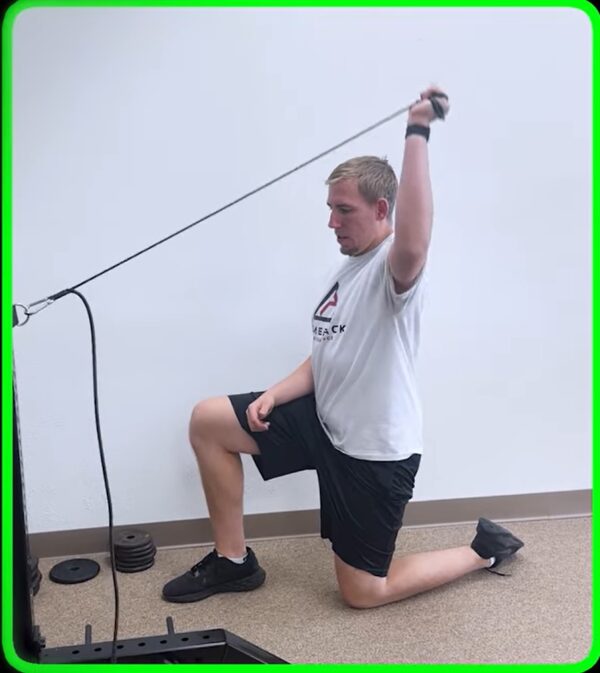
Purpose: This compound movement trains infraspinatus function through a complete movement chain, teaching it to maintain stability while other muscles move your arm through complex patterns.
Equipment Needed: Resistance band or cable machine.
How to Do It
- Start in a rowing position and pull back into a row, bringing your elbow to your side.
- From the row position, externally rotate your shoulder while keeping your elbow at your side.
- From the external rotation position, press overhead while maintaining the position of your shoulder blades.
- Reverse the sequence to return to the starting position.
Sets: 2-3 sets of 6-8 reps per side.
Tip: Move slowly through each phase. This trains your infraspinatus to maintain shoulder stability as you move through multiple positions – precisely what it needs to do in real life.
Exercise 4: Banded Pulses to Overhead
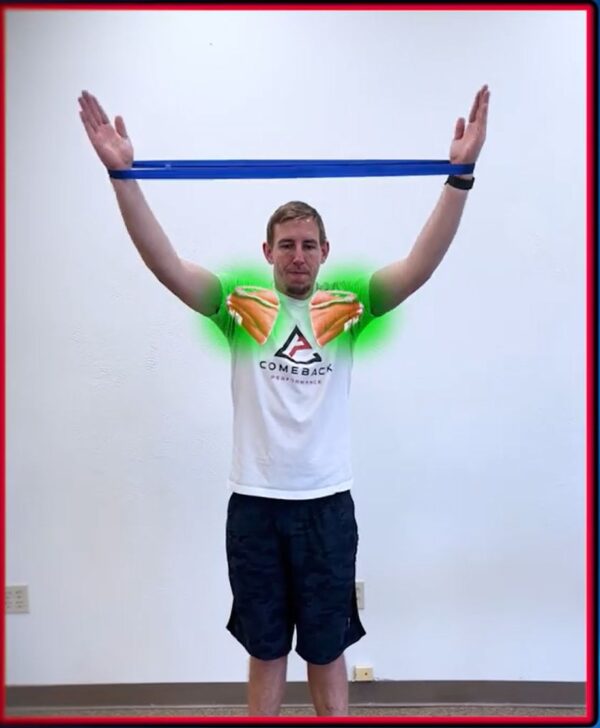
Purpose: Trains infraspinatus endurance and rapid force production – two qualities essential for shoulder stability during dynamic movements.
Equipment Needed: Light resistance band.
How to Do It
- Start with your arms at shoulder height, holding a band around your wrists to create tension.
- Perform small, rapid outward pulses (external rotation) while slowly raising your arms overhead.
- Continue the pulses as you lower your arms back down.
- Maintain good posture throughout – no rib flaring or neck tension.
Sets: 2 sets of 20-30 seconds.
Tip: Focus on small, rapid pulses rather than large movements. This trains rapid muscle activation – the ability of your infraspinatus to turn on quickly when your shoulder needs stability.
Exercise 5: Banded Perturbations at 90°
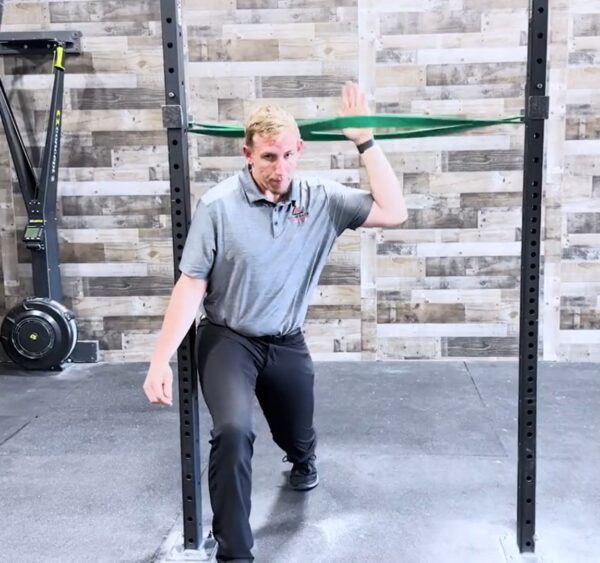
Purpose: The ultimate infraspinatus challenge – trains your muscle to maintain stability when unexpected forces try to move your arm, precisely what happens in real life.
Equipment Needed: Resistance band and a partner (or anchor point for solo training).
How to Do It
- Raise your arm to 90° at shoulder height with your elbow bent to 90°.
- Tap for resistance with a band from different directions while you maintain your arm position.
- Your job is to resist the perturbations and keep your forearm level and steady.
- If training solo, anchor a band and create your own directional changes.
Sets: 2 sets of 20-30 seconds per side.
Tip: This is an advanced exercise for the infraspinatus. Start with light, controlled perturbations and progress as you master the stability. You’re teaching your shoulder to maintain stability against unpredictable forces.
Ready To Go!
These exercises will light up the back of your shoulders, in a good way! You’ll likely notice improved shoulder stability and reduced pain with them. Your infraspinatus needs to learn these new movement patterns and build strength in functional positions. While these exercises provide immediate relief by addressing infraspinatus weakness, you may need complete shoulder rehabilitation that addresses all the components of the big five system.
Biggest thing that holds people back from getting rid of their shoulder pain is not knowing what to do. Reach out for a free consult to see the big 5 areas and uncover the root cause of the shoulder pain.
About the Author: Dr. Joey Seyforth


