
Level Up Your Shoulder Stability: 5 Expert-Approved Exercises to Eliminate Weakness and Pain
Do your shoulders feel weak, unstable, or unpredictable during everyday activities? You’re not alone. Shoulder instability affects millions of people worldwide, turning simple tasks like reaching overhead, lifting groceries, or even sleeping into painful challenges. However, these shoulder stability exercises for weak shoulders can eliminate these weaknesses.
Your shoulder is designed like a golf ball sitting on a tee. This ball-and-socket joint provides incredible mobility, allowing movement in every direction. But when stability is compromised, that “golf ball” starts bouncing around instead of staying centered. This creates a dangerous chain reaction. Your shoulder begins rubbing against tendons, getting compressed in tight spaces, and forcing your body into harmful positions that lead to pain, inflammation, and long-term damage. What starts as minor discomfort quickly escalates into chronic pain that limits your ability to live an active, fulfilling life.
The good news is that you can restore shoulder stability and eliminate pain with just 15-20 minutes of targeted exercises daily. These aren’t random movements—they’re scientifically-designed stability exercises that have helped over 1,000 people worldwide reclaim their shoulder health and get back to the activities they love.
With just 15-20 minutes a day, you can
- Eliminate shoulder weakness and regain confidence in overhead movements.
- Reduce pain and discomfort during daily activities like reaching, lifting, and sleeping.
- Prevent future injuries by building a stable foundation for all shoulder movements.
- Improve athletic performance with enhanced shoulder control and power.
- Restore full range of motion without fear of pain or instability.
- Sleep better without being woken up by shoulder discomfort.
Quick Reference Guide
- Total Time: 15-20 Minutes
- Targets: Rotator cuff muscles, deltoids, and stabilizing muscles around the shoulder blade
- Goals: Improve stability, reduce pain, enhance functional movement
Exercise Breakdown: From Foundation to Advanced
Exercise 1: Banded 90-Degree Perturbation
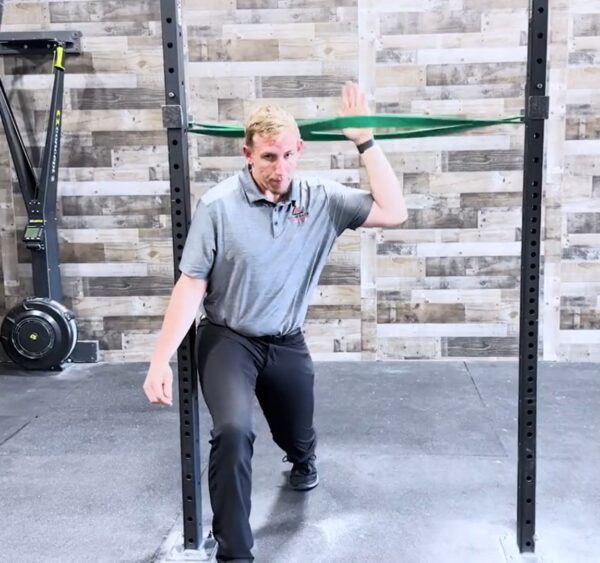
Purpose: Builds foundational stability at shoulder height while challenging your rotator cuff muscles to maintain proper positioning.
Equipment Needed: Resistance band, squat rack, or anchor point.
How to Do It
- Attach a resistance band to a rack at shoulder height.
- Position your arm at 90 degrees (like you’re about to throw a baseball) with your hand inside the band.
- Alternate tapping the band forward and backward while keeping your arm locked at 90 degrees.
- Maintain constant tension and control throughout the entire movement.
Sets: 3 sets of 30-45 seconds.
Tip: This exercise should feel like a “burner” in your shoulder muscles. If it’s too easy, use a thicker band or increase the tempo of your taps.
Exercise 2: Medicine Ball Overhead Taps

Purpose: Develops overhead stability and challenges your shoulder in multiple planes of movement through dynamic rebounding.
Equipment Needed: Medicine ball or volleyball, wall.
How to Do It
- Stand at arm’s length from a wall, holding a medicine ball overhead.
- Tap the ball against the wall at the same spot, catching the rebound with extended arms.
- Once you master the basic pattern, progress to “rainbow” taps—moving from left to right across the wall.
- Keep your arms extended throughout the entire movement pattern.
Sets: 3 sets of 30-45 seconds.
Tip: Start with the basic up-and-down pattern before progressing to rainbow movements. This exercise takes practice, so don’t get discouraged if it feels awkward initially.
Exercise 3: Shoulder Taps
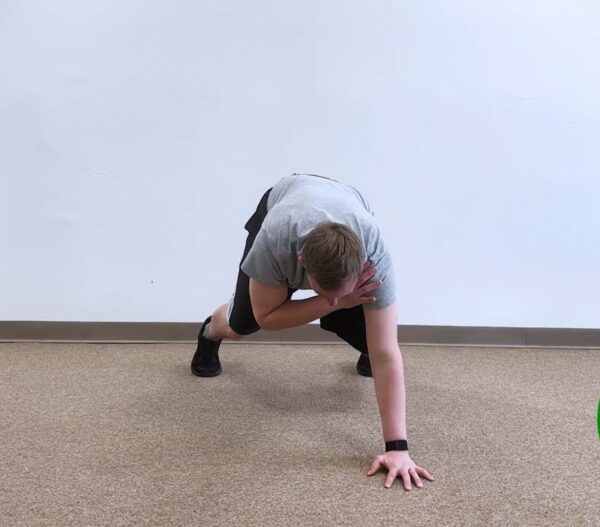
Purpose: Introduces closed-chain stability training, forcing one shoulder to support your body weight while the other moves.
Equipment Needed: None (optional: bench or box for modifications).
How to Do It
- Start in a push-up position with feet spread wider than shoulder-width.
- Keep your back flat and avoid rotating your torso.
- Slowly lift one hand to tap the opposite shoulder, then return to the starting position.
- Alternate sides while maintaining a stable plank position throughout.
Sets: 3 sets of 10 taps per side.
Tip: If this is too challenging, elevate your hands on a bench or box. Focus on loading the supporting shoulder and moving slowly—speed kills the stability benefits.
Exercise 4: Bottom-Up Kettlebell Press

Purpose: Challenges single-arm stability while requiring your shoulder to work overtime to control an unstable load.
Equipment Needed: Light kettlebell.
How to Do It
- Kneel in a half-kneeling position (the knee down should match the working arm).
- Flip the kettlebell upside down and position your elbow and shoulder at 90 degrees.
- Press the inverted kettlebell overhead, aiming to get your bicep to your ear.
- Slowly lower back to the starting position with complete control.
Sets: 3 sets of 10 repetitions per arm.
Tip: Start much lighter than you think you need—even strong athletes shake during this exercise. Remove watches or jewelry to prevent damage if the kettlebell flips.
Exercise 5: Earthquake Press

Purpose: The ultimate shoulder stability challenge, combining overhead pressing with unpredictable instability to maximize stabilizer muscle activation.
Equipment Needed: Barbell, resistance bands, kettlebells, or weights.
How to Do It
- Set up a barbell in a rack and attach bands with hanging weights (kettlebells) to both ends.
- Position the barbell on your collar bones.
- Press the unstable barbell overhead while the hanging weights create constant movement.
- Control the descent and repeat with focus on stability rather than speed.
Sets: 4 sets of 8 repetitions.
Tip: Ensure you have plenty of space around you, as the instability may cause some swaying. Start with very light weights on the bands and focus purely on control.
Your Path to Pain-Free Shoulders Starts Today
These five exercises help in systematically building the strength and control your shoulders need to function pain-free. As always, I recommend dedicating 15-20 minutes daily to these exercises, and you’ll begin noticing improvements in shoulder comfort and stability within the first week. Many people experience immediate relief from minor aches and pains, while long-term practice builds the robust shoulder stability needed for an active lifestyle.
However, if you’re currently experiencing significant shoulder pain, these exercises alone may not address the root cause of your problem. Get a shoulder assessment now!
About the Author: Dr. Joey Seyforth


