
Stop Shoulder Pain When Pressing Overhead With This 5-Minute Fix for Lifters Over 40
Are you tired of that sharp, catching pain every time you press overhead? If you’re over 40 and still hitting the gym hard, you know exactly what I’m talking about. That uncomfortable bite in your shoulder when you’re doing shoulder presses, putting plates away on the top rack, or even reaching into a high kitchen cabinet.
You can address this entire system with a simple warm-up routine that targets the root cause, not just the symptoms in 5 minutes before your workout. This approach has helped countless lifters return to pain-free pressing, including one client in his 60s who went from months of painful pressing to confidently handling 140 pounds overhead.
Quick Reference Box
- Total Time: 5 Minutes.
- Targets – The thoracic spine, lats, shoulder blades, rotator cuff, and nervous system.
- Goals: Pain-free overhead movement, improved mobility, injury prevention.
Exercise 1 – Bench Opener

Purpose: Unlocks your upper back and lats so your shoulder doesn’t have to “steal” motion from other areas.
Equipment Needed: Bench or sturdy surface, optional small dowel.
How to Do It
- Kneel in front of a bench and place your elbows on the surface, hands together or holding a small dowel.
- Slowly sit your hips back and let your chest drop toward the floor.
- Stop before any sharp pain—you should feel a stretch across your shoulders and into your lats.
- Hold for a few seconds, and then return to the starting position.
Sets: 10 slow reps, holding each stretch for 2-3 seconds.
Tip: Think “chest dropping between the arms” rather than cranking into a painful pinch. This creates breathing room at the top of your press.
Exercise 2: Wall Slides

Purpose: Teaches your shoulder blade and joint to move together in a controlled overhead path.
Equipment Needed: Wall.
How to Do It
- Stand facing a wall with one foot slightly in front, forearms or hands on the wall at shoulder height.
- Gently press into the wall and slowly slide your arms upward.
- Allow your chest to move slightly toward the wall as you slide up.
- Only go as high as comfortable without sharp pinching, then slide back down.
Sets: 10-15 smooth repetitions.
Tip: Keep your ribs down and avoid arching your lower back to “fake” the range. Let your shoulder blades naturally slide and rotate around your rib cage.
Exercise 3: Incline Row + External Rotation + Press
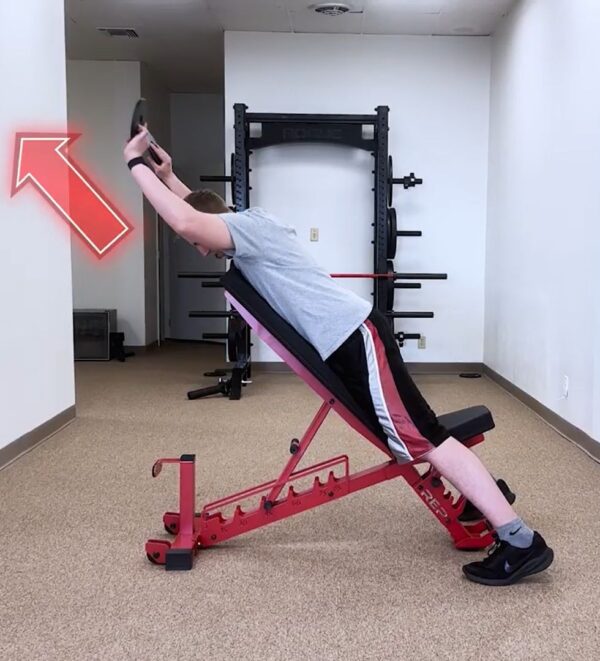
Purpose: Integrates rowing, external rotation, and pressing into one coordinated movement pattern.
Equipment Needed: An incline bench, light weights, or bodyweight.
How to Do It
- Set a bench to a low incline and lie chest-down, arms hanging straight.
- Row the weights up, squeezing shoulder blades gently down and back.
- From the top position, externally rotate arms up into a “goalpost” position.
- Press the weights slightly up and forward in line with your shoulders, then reverse the sequence.
Sets: 10 controlled repetitions with light weight.
Tip: This is about patterning, not maximum effort. Think “row, rotate, press” in one smooth sequence—you should feel it in the back of your shoulders, not just the front.
Exercise 4: Banded Scaption
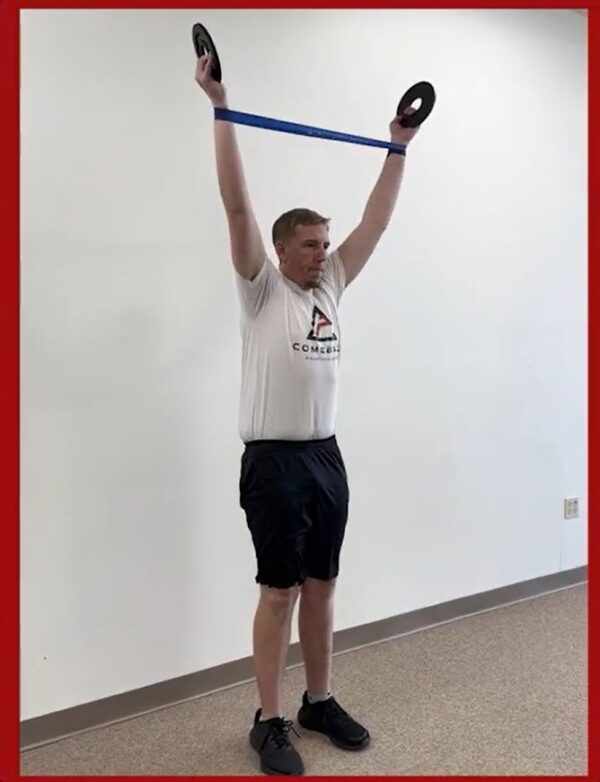
Purpose: To create an easier overhead path in the scapular plane, which is good for your shoulders.
Equipment Needed: A circle resistance band or light weights.
How to Do It
- Place a circle band around wrists and create tension by pulling hands apart.
- With elbows mostly straight, raise your arms up and out at a 30-45° angle from your body.
- Lift to about shoulder-to-ear height, then lower with control.
- Focus on reaching long rather than shrugging shoulders.
Sets: 2 sets of 8-10 reps (about 1 minute total work).
Tip: Stay in the “green” and “yellow” pain zones. This scapular plane path is much more shoulder-friendly than straight overhead, especially after 40.
Exercise 5: Downward Dog
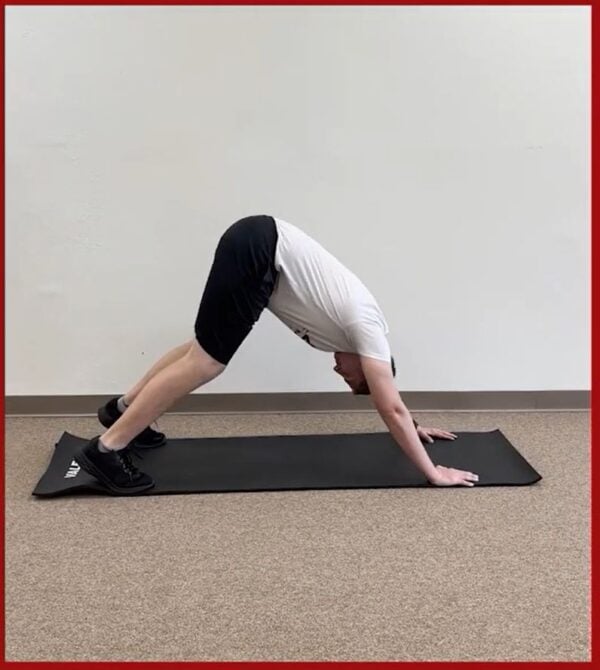
Purpose: To prepare your shoulders for overhead load-bearing in a safer, more stable position.
Equipment Needed: None. You’ll need a box or bench for hand elevation but that’s optional.
How to Do It
- Start in a push-up position with hands under shoulders and body in a straight line.
- Slowly lift hips up and back, bringing chest toward thighs in an upside-down V.
- Let your head rest between your arms, eyes toward your feet.
- Hold briefly, then return to the starting position.
Sets: 8-10 slow reps (about 1 minute total).
Tip: Don’t force the maximum range; focus on pushing the floor away and lengthening through the shoulders and upper back. You can elevate hands on a box if the floor position is too aggressive.
How to Use This 5-Minute Routine
When to Use It:
- Before any overhead pressing day at the gym
- Before shoulder press, dumbbell press, or overhead work
- Whenever you know you’ll be putting weights overhead
- Daily for 2-3 weeks if recovering from impingement or bicep tendinitis
What to Monitor:
- How does the top of your press feel during workouts
- Shoulder comfort after overhead training sessions
- Whether daily overhead tasks (reaching cabinets, etc.) feel less “sketchy.”
Your Next Steps to Pain-Free Pressing
This 5-minute warm-up addresses the most common overhead movement dysfunctions, but every lifter’s situation is unique. Perform this routine before every overhead session and monitor how your shoulders respond over 2-3 weeks. If you’re still experiencing that classic impingement-type shoulder pain when pressing overhead, you may need a more targeted approach to identify which specific areas of your Big Five system need the most attention.
Take the next step.
About the Author: Dr. Joey Seyforth


