
Stretching Only Won’t Fix Shoulder Pain When Pressing, But This Will
That nagging, sharp pain in the front of your shoulder every time you bench press or do a push-up is more than just an annoyance; it’s a roadblock. If you’ve been religiously stretching your pecs before every workout, hoping to create more room and find relief, you might be shocked to learn you could be making the problem worse.
I know that sounds backward, but hear me out.
In this article, we’ll show you a powerful, four-exercise routine that takes less than 15 minutes to eliminate that pain and build a resilient foundation for all your pressing movements.
Quick Reference Box
Total Time: 10-15 Minutes
Targets: Scapula (Shoulder Blade), Rotator Cuff (Subscapularis, Posterior Cuff), Lower Traps, Posterior Deltoids
Goals: To reduce front shoulder pain during pressing. Improve motor control and stability of the shoulder joint, and optimize shoulder blade movement for pain-free mechanics.
The 4 Exercises to Fix Your Front Shoulder Pain
Here is the exact routine to build control and end your push-day pain for good.
Exercise 1: Wall Slides

Purpose: This is to teach your shoulder blade to rotate upward and tilt backward, creating the necessary space for your shoulder to press without jamming the joint.
Equipment Needed: None (just a wall).
How to Do It
- Stand facing a wall with the pinky-edge of your hands and forearms placed on it.
- Gently press your forearms into the wall.
- Slowly slide your arms upward along the wall as high as you can without shrugging your shoulders or losing contact.
- Control the movement as you slide back down to the starting position.
Sets: Do 2 sets of 12 reps.
Tip: Focus on the feeling of your shoulder blades moving around your ribcage. Keep the pressure into the wall light but constant.
Exercise 2: Banded Extension & External Rotation

Purpose: This exercise trains the muscles on the back of your shoulder to do their job.
Equipment Needed: A light resistance band.
How to Do It
- Hold a resistance band with both hands and place it behind your lower back.
- Pull your arms back into extension while simultaneously rotating your forearms outward, stretching the band.
- Feel the muscles on the back of your shoulders and your upper back engage to open up your chest.
- Hold for a second, then slowly return to the start.
Sets: Do 2 sets of 10 reps.
Tip: Avoid arching your lower back. Instead, the movement should come from your shoulders.
Exercise 3: Quadruped Scapular Depressions
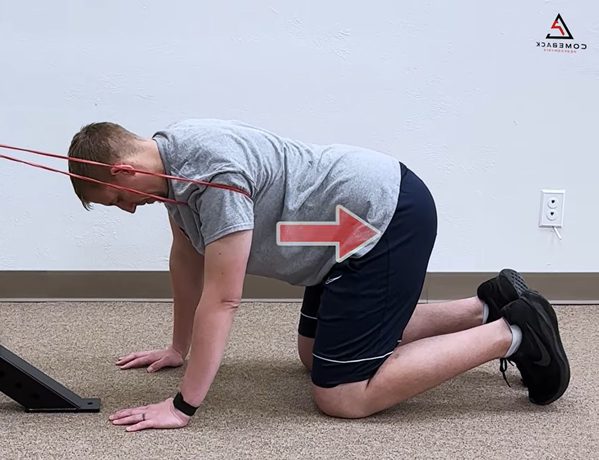
Purpose: To directly isolates your lower traps, the crucial muscles that pull your shoulder blade down and back.
Equipment Needed: A light resistance band.
How to Do It
- Get on your hands and knees with a resistance band looped around one shoulder, anchored under the opposite knee.
- Keeping your elbow straight, actively pull your shoulder blade down and slightly back against the band’s resistance.
- Imagine you are pulling your shoulder blade into your opposite back pocket.
- Slowly allow the band to pull your shoulder blade back up to the starting position.
Sets: 2 sets of 12 reps (per side)
Tip: If you’re bending your elbow or moving your whole torso, you’re compensating.
Exercise 4: Banded Subscapularis Punch
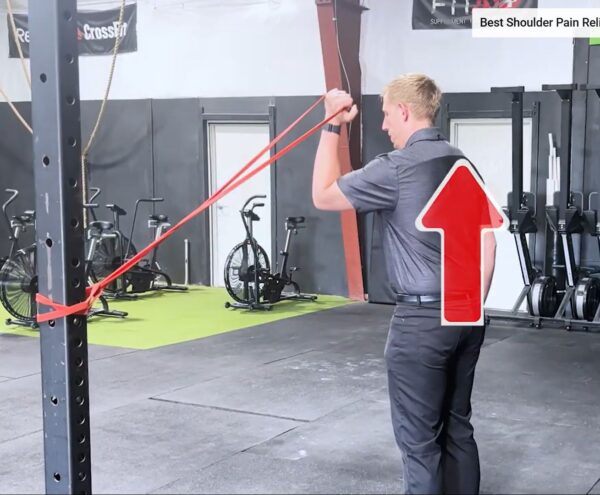
Purpose: This is the final piece. It fires up your subscapularis, a powerful internal rotator of the rotator cuff that acts like a seatbelt, preventing the ball of the shoulder from sliding forward under the load of a press.
Equipment Needed: A light resistance band.
How to Do It
- Anchor a resistance band to the side at about chest height.
- Stand with your elbow bent at 90 degrees, holding the band.
- Punch your arm upward and slightly forward against the band’s tension, mimicking the top of a pressing motion.
- Control the motion as you return your arm to the 90-degree starting position.
Sets: 3 sets of 8 reps (per side)
Tip: Don’t let the band snap your arm back; control every inch of the movement.
From Quick Wins to a Long-Term Solution
Fixing how your shoulder moves is the key to making push day stop hurting. But this is just the beginning. The shoulder is part of a larger system we call the “Big Five”: your neck, thoracic spine, shoulder blade, shoulder joint, and nerves. A problem in any one of these can manifest as shoulder pain.
To help you find the true source of your issue, I’ve put together a free Big Five Shoulder Fix guide. It includes simple tests and exercises to figure out exactly what’s feeding your pain so you can stop guessing and start training the right thing.
About the Author: Dr. Joey Seyforth


