
Stop Stretching Your Shoulder Pain Away: These 3 Exercises Bring Relief
Have you been told that stretching is the answer to your nagging shoulder pain? You’re not alone in this frustrating cycle. If you’ve been diligently doing doorway stretches, using bands, and rolling on foam rollers for weeks or even months, only to have that tight, pinching sensation return again and again, it’s time to face an uncomfortable truth: stretching might be making your shoulder pain worse. In this blog, I talked about what to do for shoulder pain instead of stretching!
That discomfort isn’t just a flexibility issue. Your body’s alarm system is acually telling you something is wrong. To put it in another light, it’s your shoulder actually guarding against instability by creating protective tension to prevent injury. When you stretch a joint that lacks proper control, you’re essentially pulling on a frayed rope, creating temporary relief while making the underlying problem worse.
The chain reaction extends throughout your entire upper body. Your shoulder blade, rib cage, and rotator cuff muscles are all working overtime to compensate for this lack of stability. The resultant effect is a domino effect that can lead to neck pain, upper back tension, and even headaches. The good news? With just 10-15 minutes a day using the right approach, you can break this cycle and finally get lasting relief.
With just 10-15 minutes a day, you can
- Eliminate that constant, tight, pinching sensation in your shoulder
- Build bulletproof stability that prevents future pain episodes.
- Improve your ability to reach overhead without discomfort.
- Reduce popping and clicking in your shoulder joint.
- Regain confidence in daily activities like lifting, carrying, and exercising.
- Develop long-term resilience that keeps you pain-free for life.
Quick Reference Guide
- Total Time: 10-15 Minutes.
- Targets: Rotator cuff, shoulder blade, and upper back muscles.
- Goals: Build stability, improve control, eliminate compensatory tension.
Exercise Breakdown
Exercise 1: Windmill Lift Off
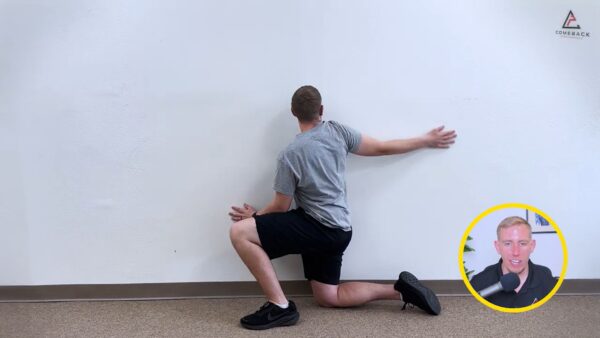
Purpose: Builds active thoracic and shoulder mobility and teaches your body to move with strength through its available range.
Equipment Needed: Wall space
How to Do It
- Start in a half-kneeling position next to a wall with your hip touching the wall.
- Slide your arm up along the wall while following it with your eyes and rotating your upper body.
- Pause at the end of your comfortable range, then lift your arm slightly off the wall without losing that rotation.
- Lower back to the wall, return, and repeat the movement.
Sets: 10 reps on each side
Tip: Don’t force the motion. Instead, work within ranges that feel comfortable. You should feel your shoulder blade gliding and your rib cage opening, not straining.
Exercise 2: Banded Axial Rotations
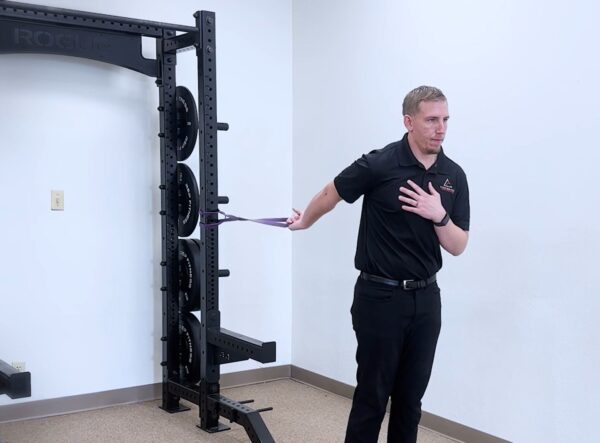
Purpose: Teaches your rotator cuff to handle load while maintaining proper joint alignment, especially effective for reducing popping and clicking.
Equipment Needed: Resistance band and anchor point.
How to Do It
- Attach a resistance band to a stable anchor point and step out so it’s pulling your arm from behind.
- Keep your elbow straight and slowly rotate your palm upward, then downward.
- Focus on controlled, intentional movement – no rushing.
- Feel the subtle distraction at your shoulder joint as you build stability.
Sets: 2 sets of 45 seconds
Tip: The band creates gentle traction that frees up your shoulder joint while you train control. This combination is what builds bulletproof stability in vulnerable positions.
Exercise 3: Row, External Rotation, and Press

Purpose: Integrates multiple movement patterns to retrain your brain and body for coordinated, pain-free shoulder function.
Equipment Needed: Resistance band or cable system.
How to Do It
- Start by performing a rowing motion, pulling your shoulder back
- Rotate your arm back like you’re preparing to throw a ball
- Press your arm overhead in one fluid, intentional movement
- Reverse the pattern slowly and with control
Sets: 2 sets of 8-10 reps
Tip: Think of this as retraining your entire movement pattern, not just exercising individual muscles. Complete the full range of motion with each repetition.
Why Control Beats Stretching Every Time
The fundamental difference between these exercises and traditional stretching lies in one key concept: control is king. When you stretch a shoulder that lacks stability, you’re addressing the symptom (tightness) rather than the cause (lack of control). Your shoulder is built for incredible mobility, but like a golf ball balanced on a tee, it needs perfect stability from surrounding muscles to function properly.
These exercises teach your shoulder to move with strength and coordination through its available range. Instead of forcing more motion, you’re building the neuromuscular control that your body is actually craving. This is why people who do endless stretching often find temporary relief that never lasts—they’re not addressing the root cause.
The good news is that once you start building this smart, stable movement, you’ll notice improvements quickly. Many people report feeling more confident in their shoulder movement within just a few days of consistent practice.
Your Path to Lasting Shoulder Freedom
Dedicate just 10-15 minutes each day to these three exercises, and you’ll start experiencing the immediate benefits of reduced tension. These exercises are building something bigger – long-term resilience that keeps you pain-free and confident in your daily activities.
If you’ve been trapped in the stretch-strengthen-stretch cycle and are still dealing with persistent pain, don’t lose hope. The tightness you feel is a signal, not the problem itself. When you give your shoulder what it’s really asking for—control, stability, and coordinated movement—you’ll finally break free from the pain cycle.
Want a tailored, step-by-step approach to eliminate your shoulder pain permanently? It’s time to work with a specialist who understands that your comeback can be stronger than your setback.
About the Author: Dr. Joey Seyforth


