
Stop Pull-Up Shoulder Pain: 3 Simple Fixes That Actually Work
Most people experiencing shoulder pain during vertical pulling exercises make the same critical mistake; they grip the bar, hang loose, and hope their shoulder magically stops hurting. When that doesn’t work, they either push through the pain or abandon pull-ups altogether, losing one of the most effective upper-body exercises in the process.
Your shoulder pain during pull-ups stems from a chain reaction of mechanical failures that extend far beyond your shoulder joint. However, with just 10-15 minutes of targeted corrective exercises, you can address the root mechanical issues causing your shoulder pain.
Quick Reference Guide
- Total Time: 15 Minutes
- Targets: Shoulder blades, lats, shoulder joint mechanics
- Goals: Pain reduction, proper muscle activation, movement quality
Exercise #1: Banded I’s for Active Support
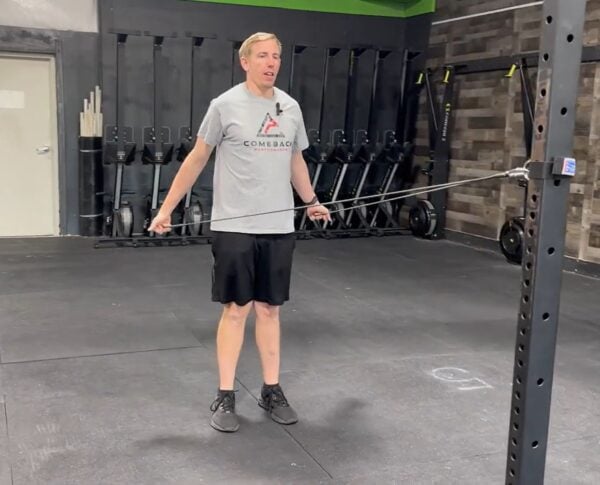
Purpose: To teach your shoulder blades to actively support your shoulder joint instead of hanging passively.
Equipment Needed: Light resistance band, anchor point.
How to Do It
- Attach a light band to an anchor point in front of you and stand facing the anchor.
- Hold the band with both hands, arms extended in front, palms facing up.
- Step back until there’s light tension in the band.
- Pull your arms back until your hands are in your pockets, then squeeze your shoulder blades down and back.
- Slowly return to the starting position with control.
Sets: 2-3 sets of 10-12 reps.
Tip: Think “shoulder blades down and back” rather than “pull with arms.” This builds the active support pattern you need at the bottom of every pull-up.
Exercise #2: Quad Kneel Scap Depression
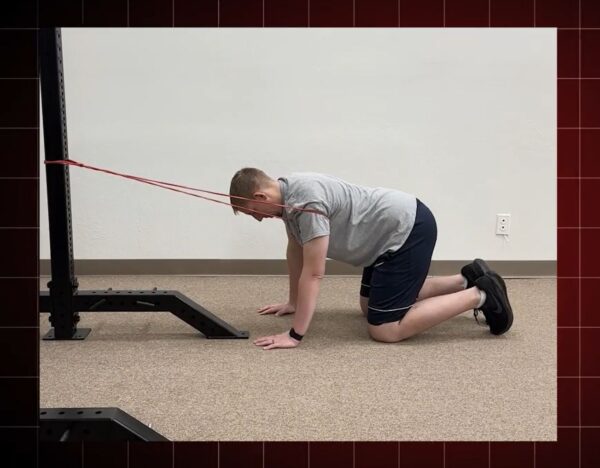
Purpose: Train your shoulders to depress and move away from your ears, creating space in the shoulder joint.
Equipment Needed: Resistance band, anchor point.
How to Do It
- Get into a quadrupod position (hands and knees) with a band attached to a rig in front of you.
- Loop the band around the top of your shoulders, with your hands directly under your shoulders.
- Allow the band to pull your shoulder forward and up gently.
- Press your hand into the floor and draw your shoulder down toward your back pocket.
- Return to the starting position.
Sets: 2-3 sets of 10-12 controlled reps.
Tip: Think “long neck, shoulders away from ears” at the bottom position. This is the exact pattern you need at both the bottom and top of a pull-up to avoid impingement.
Exercise #3: Banded Lat Pulldowns
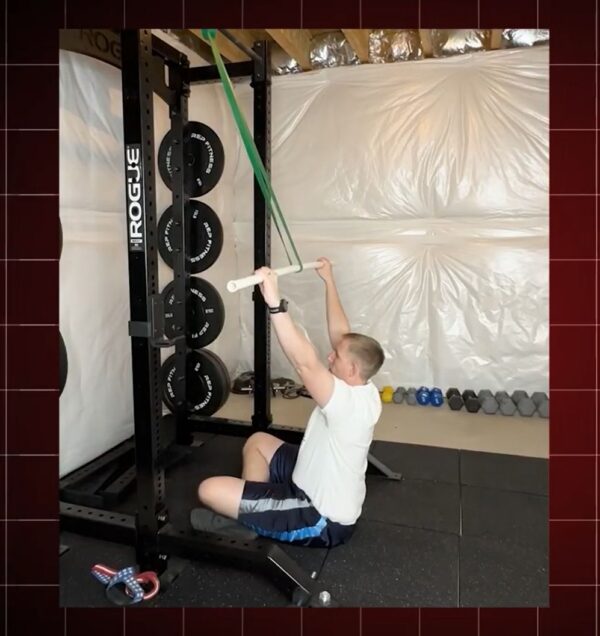
Purpose: To activate your lat muscles to take the load off your shoulder joint.
Equipment Needed: Resistance band, PVC pipe, or anchor point.
How to Do It
- Loop a band through a PVC pipe and sit on the ground.
- Place your hands in a pull-up grip, arms overhead.
- Pull down into a lat pulldown position, focusing on squeezing your lats.
- Return to the starting position.
Sets: 2-3 sets of 8-10 reps.
Tip: If you don’t feel your lat muscles (the big muscles on the sides of your back), adjust your hand position until you can engage them. Think “elbows to back pockets” rather than “hands to shoulders” to maximize lat activation.
The 3 Mechanical Problems Destroying Your Shoulders
Problem #1: Dead Hanging on Passive Structures
Most people jump on the pull-up bar and immediately go completely loose. They hang off their ligaments and joints instead of actively supporting themselves through their shoulder blades. This hanging dumps all the load directly into the front of your shoulder joint and surrounding tissues, creating that familiar pinching sensation.
Why this happens: Your shoulder blades aren’t engaging to provide the stable platform your shoulder joint needs for safe pulling.
Problem #2: Constant Shoulder Shrugging
Your shoulders rise by your ears throughout the entire pull-up range of motion. There’s no control over shoulder blade depression or rotation—just a constant shrug that jams everything at the top and front of your shoulder.
Why this hurts: When your shoulders can’t fully depress, the space in your shoulder joint becomes compressed, leading to impingement and pain during movement.
Problem #3: Bicep-Dominant Pulling Pattern
Instead of driving the movement through your lats and shoulder blades, you curl your way up using your biceps primarily. This compensation pattern forces the front of your shoulder to handle way more load than it should.
The result: Your shoulder joint becomes overworked while your strongest pulling muscles—your lats—remain underactive and weak.
Get Back to the Pull-Ups You Love
For most healthy shoulders, some form of pull-up or lat pulldown should be possible when the mechanics are right. Whether that’s band-assisted pull-ups, eccentric-only reps, or controlled lat pulldowns, you don’t have to give up vertical pulling forever.
Start with these three exercises today, dedicating just 15 minutes to correcting fundamental movement patterns. You’ll be amazed at how quickly your shoulders start feeling better during vertical pulls.
Don’t let shoulder pain force you into early retirement from the exercises you love—take action today.
About the Author: Dr. Joey Seyforth


