
5 Exercises for Real Shoulder Stability
If your shoulder clicks, pops, shakes, or feels unreliable during daily activities or workouts, you should read through this piece or watch the attached video. The common advice is often to stretch more. But what if that’s the exact opposite of what your shoulder needs?
Shoulder instability happens when your shoulder system loses control, causing the ball-and-socket joints of your shoulders to shift, shake, or feel like they might slip.
This is why more stretching can fail, as it adds range of motion to a joint that can’t even control the range it already has. The good news is that you can retrain your shoulder system to feel centered and secure in just a few minutes a day with these exercises we’ve shared below.
Quick Reference Box
- Total Time: 10-15 Minutes
- Targets: Rotator Cuff, Shoulder Blade, Nervous System Control
- Goals: Improve Shoulder Stability, Reduce Pain & Clicking, Build Functional Strength
5 Exercises to Stabilize Your Shoulder
Here are the five-exercise routine designed to build control and resilience in your shoulder.
Exercise 1: Banded Pulses
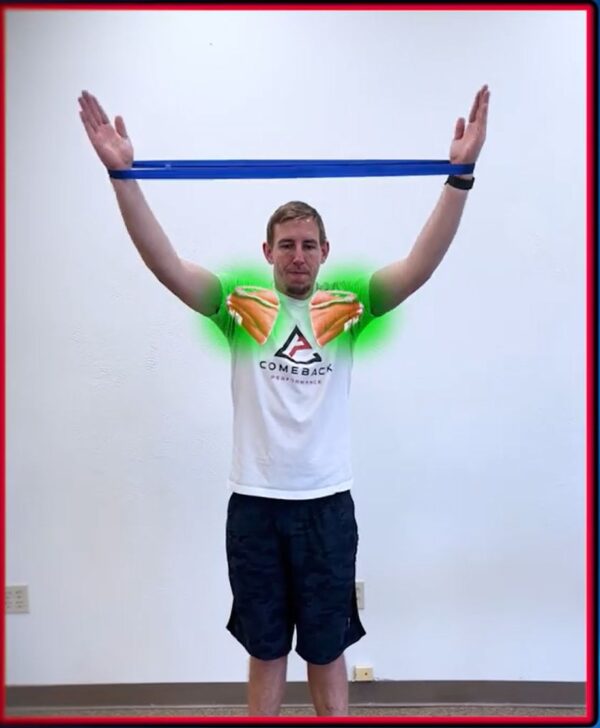
Purpose: To build rotator cuff endurance and control as you move your arm overhead.
Equipment Needed: A light resistance band.
How to Do It
- Place a resistance band around both wrists.
- Provide slight outward tension on the band to engage your rotator cuff.
- Slowly raise your arms up and down, pulsing in and out against the band’s tension.
Sets: Do 3 sets of 8 pulses.
Tip: Focus on continuous control and tension. The goal is not a large range of motion, but steady muscle activation.
Exercise 2: Subscap Punch
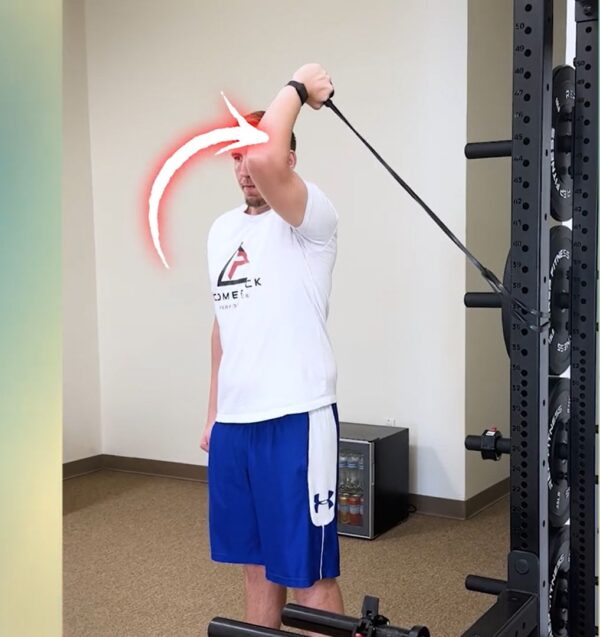
Purpose: To train the front of the rotator cuff (subscapularis) to prevent the ball of the shoulder from drifting forward.
Equipment Needed: A resistance band.
How to Do It
- Anchor a band at your side at about hip height.
- Keep your elbow tucked into your side and grab the band.
- Push your arm upward in a “punching” motion until your bicep approaches your ear.
- Return slowly to the starting position, controlling the resistance.
Sets: Do 2 sets of 10-12 reps per side.
Tip: The return trip is just as important as the punch up. Move slowly and with intention.
Exercise 3: Extension Rocks

Purpose: To build stability in the bottom position of movements like dips or bench presses, where many people feel pain.
Equipment Needed: None (or a bench for an easier variation).
How to Do It
- Sit on the floor with your hands behind you, knees bent, and your feet flat on the floor.
- Lift your hips slightly off the ground so your weight is supported by your hands and feet.
- Gently rock your body forward and backward, allowing your shoulders to move through a controlled range of extension.
Sets: 2 sets of 12 rocks.
Tip: Keep your chest proud and your shoulders pulled away from your ears to maintain good posture. If this is too intense, elevate your hands on a low bench or step.
Exercise 4: Shoulder Taps
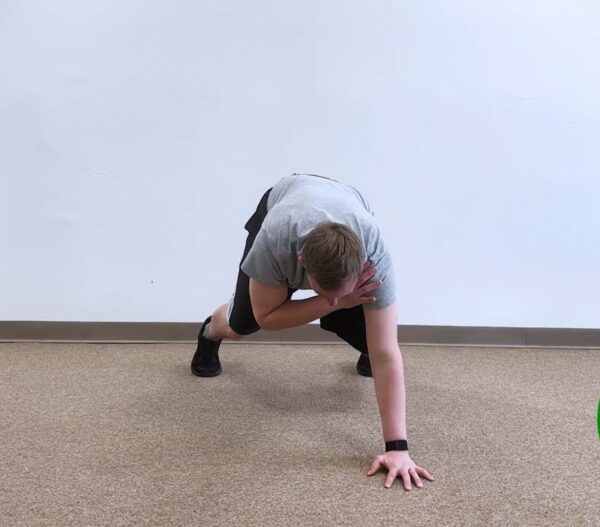
Purpose: To build closed-chain stability and teach your shoulder blade and joint to stay centered while load shifts.
Equipment Needed: None
How to Do It
- Start in a push-up or plank position.
- Keeping your core tight, shift your weight onto one arm.
- Slowly lift the other hand and tap your other shoulder.
- Return your hand to the floor and repeat on the other side.
Sets: 2 sets of 8-10 taps per side.
Tip: The key is to keep your hips and ribs quiet. Avoid rocking side-to-side. If you struggle with this, perform the exercise with your hands elevated on a bench or wall.
Exercise 5: Sideline External Rotation Ball Toss
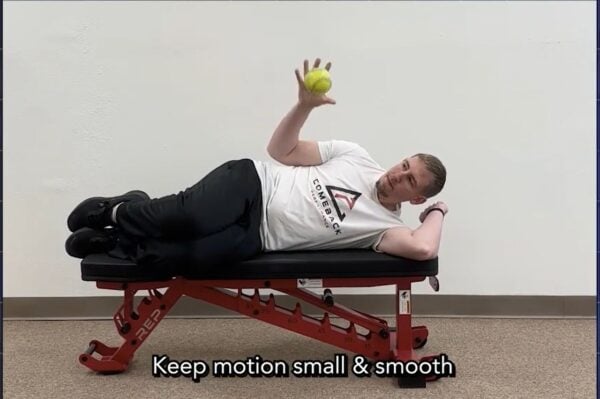
Purpose – To develop reactive stability and the shoulder’s ability to make rapid, unconscious adjustments.
Equipment Needed: A light ball (1-2 lbs)
How to Do It
- Lie on your side with your working arm on top. Support your elbow with a small towel roll if needed so it’s near your body.
- Bend your elbow to 90 degrees.
- Perform small, quick tosses and catches with a light ball, moving through a comfortable external rotation range.
Sets: 3 rounds of 20-30 seconds.
Tip: This is about quick reactions, not power or range. Start this exercise only after the slower drills feel secure and pain-free.
From Quick Fix to Long-Term Solution
You should perform this routine three to four times per week, or use it as a warm-up before upper body training. While these exercises are a fantastic starting point, true, lasting relief comes from understanding your specific situation.
If you’re tired of cookie-cutter rehab and ready to build a truly resilient shoulder, it’s time to look at the entire system.
About the Author: Dr. Joey Seyforth


