
Fix Your Nightly Shoulder Pain With This 10-Minute Routine
If you’ve bought a collection of pillows trying to find relief from shoulder pain that jolts you awake at night, I need you to stop right there. The good news is, it was never the pillow. Tossing and turning, constantly flipping sides, and searching for a painless position isn’t a comfort issue; it’s a sign that your shoulder physically cannot support itself when you’re at rest. That aching pain is your body’s alarm bell, and we’re about to show you how to answer the call with just a few minutes and four simple exercises.
Quick Reference Box
- Total Time: 10 Minutes
- Targets: First Rib, Thoracic Spine, Shoulder Stabilizers (Lower Traps, Serratus), Nervous System
- Goals: Reduce night pain, improve shoulder stability, and increase mobility.
The 4-Exercise Routine for Pain-Free Sleep
Perform this routine daily, ideally before bed, to prepare your body for a restful night. Always listen to your body and work within a pain-free range of motion.
Exercise 1: Belt First Rib Mobilization

Purpose: To create space and free up the first rib, relieving the nerve tension that gets trapped when you sleep on your side.
Equipment Needed: A belt (or a firm, non-stretchy strap).
How to Do It
- Sit on a chair and place one end of the belt under you to anchor it.
- Drape the belt over the top of your shoulder/trap muscle on the painful side and pull down firmly to create tension.
- Slowly tilt your head, looking down and into the opposite armpit, then alternate by looking up and away from the anchored side.
Sets: Do 2 sets of 15 reps.
Tip: To get the best result, perform this exercise about 5 minutes before you get into bed. This can be a game-changer.
Exercise 2: Sidelying Open Book

Purpose: To restore rotation in your mid-back (thoracic spine), which allows your shoulder to sit back in a more natural position instead of being jammed forward.
Equipment Needed: None.
How to Do It
- Lie on your non-painful side with your hips and knees bent at a 90-degree angle. Extend both arms straight out in front of you with palms together.
- Keeping your hips stacked, slowly rotate your top arm and chest open toward the ceiling, as if opening a book. Follow your hand with your eyes.
- Go as far as you can comfortably, then slowly return to the starting position.
Sets: 2 sets of 10 reps per side.
Tip: Focus on rotating from your chest and mid-back, not just moving your arm. Keep the movement slow and controlled.
Exercise 3: Half-Kneeling Banded Y-Raise
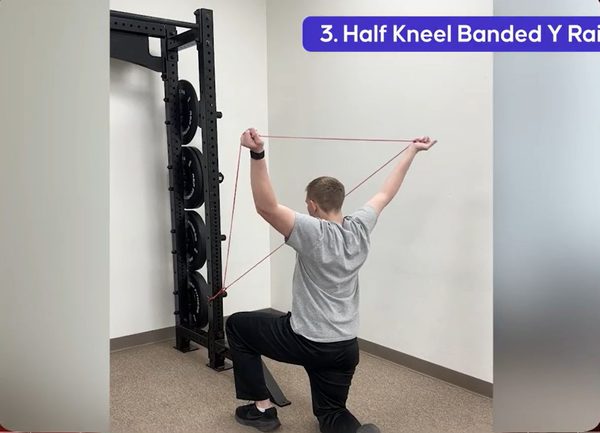
Purpose: To activate and train your lower traps and serratus—key muscles that position your shoulder blade correctly so your rotator cuff isn’t getting crushed.
Equipment Needed: A light resistance band.
How to Do It
- Get into a half-kneeling position (one knee down, one foot forward). Hold a resistance band with both hands, palms facing each other.
- Keeping your arms straight, raise them up and out overhead into a “Y” shape, creating light tension in the band.
- Hold for a second at the top, focusing on squeezing your shoulder blades down and back, then slowly lower your arms back down.
Sets: 2 sets of 10 reps.
Tip: Engage your core to prevent your lower back from arching as you raise your arms. The movement should come from your shoulder blades.
Exercise 4: Bear Position Shoulder Taps
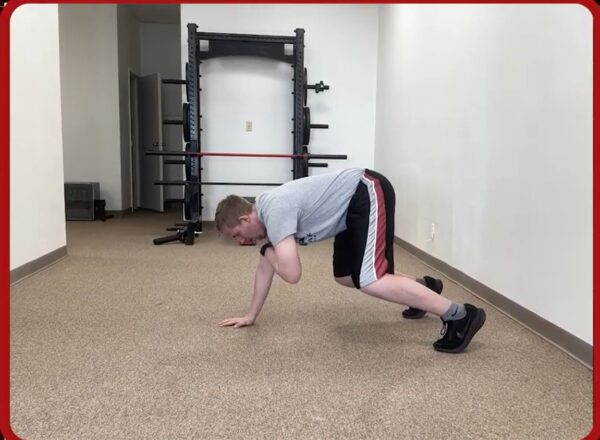
Purpose: To teach your shoulder how to properly stabilize and handle load, preparing it for the pressure of lying on it at night.
Equipment Needed: None.
How to Do It
- Start on all fours in a tabletop position with your hands under your shoulders and knees under your hips.
- Engage your core and lift your knees just an inch or two off the floor.
- Slowly lift one hand to tap the opposite shoulder, keeping your body as still as possible.
- Return your hand to the floor and switch sides.
Sets: 2 sets of 8-10 reps per side.
Tip: The goal is to prevent your hips from rocking side-to-side. A wider foot stance can make this easier as you begin.
Finding A Permanent Solution
By consistently performing this routine, you are building a stronger, more resilient shoulder that can finally rest the way it’s supposed to.
Many of our clients, like Pat, went from waking up multiple times a night to sleeping soundly just by addressing the root causes we discussed today, especially that hidden nerve tension at the first rib. While these exercises provide immediate relief, a truly long-term solution involves looking at your entire shoulder system.
About the Author: Dr. Joey Seyforth


