
The REAL Reason Your Shoulder Impingement Won’t Go Away (What To Do)
If you’ve felt that sharp, pinching pain in the front of your shoulder every time you bench press, lift overhead, or do dips, you undoubtedly know how frustrating it can be. Chances are that you’ve tried a plethora of solutions including rest, stretching, and maybe even physical therapy. Yet with these solutions, the pain returns the moment you get back to training.
Let me be clear – you’re not doing the wrong exercises; you’re likely doing exercises for th
e wrong problem. The issue isn’t just in your shoulder joint. It’s a chain reaction. In this blog, you’ll learn how to test your shoulder, find the cause of your pain, and walk you through three simple exercises to start the healing process today.
Quick Reference Guide
- Total Time: 15 Minutes
- Targets: Shoulder Blade, Shoulder Joint, and Rotator Cuff.
- Goals: To reduce impingement pain, improve shoulder blade mobility, and build functional shoulder stability.
Let’s Test Your Shoulder
You should do these two tests on your shoulders and ensure you pay close attention to how your shoulder feels. We’ll retest them after the exercises so you can see the immediate difference.
Test 1 – The Clearing Test
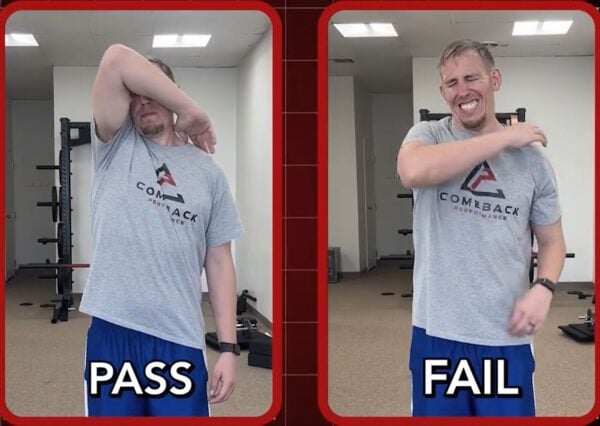
- Place the hand of your painful side flat against your opposite shoulder.
- Keeping your hand in place, lift your elbow straight up toward the ceiling.
- A positive sign is sharp or pinching pain in the front of your shoulder as your elbow rises. Take a mental note of how high you can lift and the intensity of the pain.
Test 2 – The Hawkins-Kennedy Test
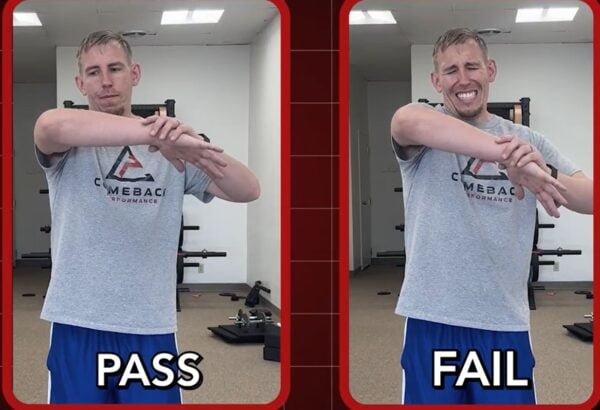
- Bring the arm of your painful side straight out in front of you, with your elbow bent at 90 degrees.
- Use your other hand to gently press down on your forearm, rotating your shoulder internally.
- A positive sign is pain in the front of the shoulder. Again, note the sensation.
If either or both of these tests “lit you up,” that’s a sign of impingement. Keep reading—we’re about to address it directly.
The 3 Exercises
Exercise 1 – Wall Slide

Purpose: To restore the upward rotation of your shoulder blade, creating the necessary space for impingement-free movement.
Equipment Needed: None (just a wall).
How to Do It
- Stand facing a wall with one foot slightly in front of the other.
- Place your forearms on the wall at shoulder height, with your elbows hovering just off the surface.
- Gently push into the wall and slide your arms upward, allowing your chest to lean forward at the top.
- Focus on letting your shoulder blades glide up and around your rib cage.
Sets: Do 2 sets of 10 slow, controlled reps.
Tip: Each rep should feel smoother than the last. This is your brain and body re-learning the correct movement pattern.
Exercise 2 – Wall Angel

Purpose: To retrain your shoulders for proper shoulder blade movement.
Equipment Needed – None (just a wall).
How to Do It
- Stand with your back flat against the wall.
- Bring your arms up into a “goalpost” position, trying to keep your elbows and the backs of your hands in contact with the wall.
- Slowly slide your arms up the wall, going as high as you can while maintaining contact.
- You should feel a stretch in the front of your chest and muscles working in your upper back.
Sets: 2 sets of 10 slow reps.
Tip: Work within the range of motion you have and don’t stretch it.
Exercise 3: Banded Bear Sliders
Purpose: To integrate the shoulder blade and shoulder joint.
Equipment Needed: A resistance band
How to Do It
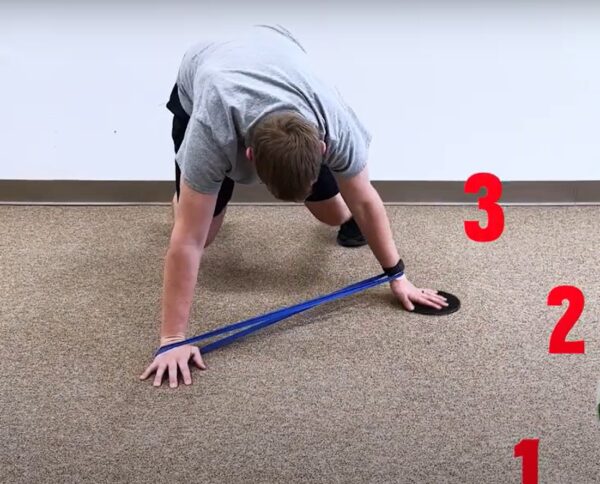
- Get on all fours in a “bear” position.
- Place a light resistance band around your wrists.
- Maintaining a flat back and tension on the band, slowly slide one hand forward, then back to the start.
- Repeat by sliding the hand out to the side, and then diagonally. Perform all slides on one side before switching to the other.
Sets: Do 2 sets of 5 slow slides in each of the 3 directions.
Tip: Focus on control, not speed.
Now that you’ve finished the exercises, let’s go back to our two tests and retest your shoulders.
Your Next Step
You’ve started to address the root mechanical cause of your shoulder impingement by starting these exercises we’ve shared abpve. However, you must be consistent in doing those exercises. Because when you make this short routine a daily habit, you will undoubtedly begin to see results. While these exercises are a fantastic starting point, true, lasting relief comes from a holistic approach.
About the Author: Dr. Joey Seyforth


