
3 Exercises to Fix Shoulder Impingement That Keeps Coming Back
You warm up, load the bar, and do three reps of your bench press, and there it is again – that pinch in the front of your shoulder, the shoulder impingement. It happens with overhead presses too, and dips are out of the question.
Here’s what nobody is telling you: you’re not doing the wrong exercises. In this guide, you’ll test your shoulder, learn why it hurts, fix it with three simple exercises, and retest to see the difference for yourself.
What These Exercises Can Do for You
With just a few minutes a day, you can:
- Restore the upward rotation your shoulder blade needs
- Give your shoulder joint room to move without pinching
- Build stability that stops impingement from returning
- Move with confidence instead of bracing for pain
- Feel better in the exact lifts that were hurting: bench press, dips, and overhead pressing
As one of our clients, Richard, put it, he’s no longer flinching and anxious about running into pain. That’s the real goal. Not just less pain, but the confidence to move again.
Quick Reference Guide
- Total Time: A few minutes
- Targets: Shoulder blade, shoulder joint
- Goals: Reduce shoulder pain, restore shoulder blade movement, build lasting stability
Test Your Shoulder First
Do these two quick tests before the exercises. You’ll repeat them at the end so you can see the change right away.
Test 1: Clearing Test
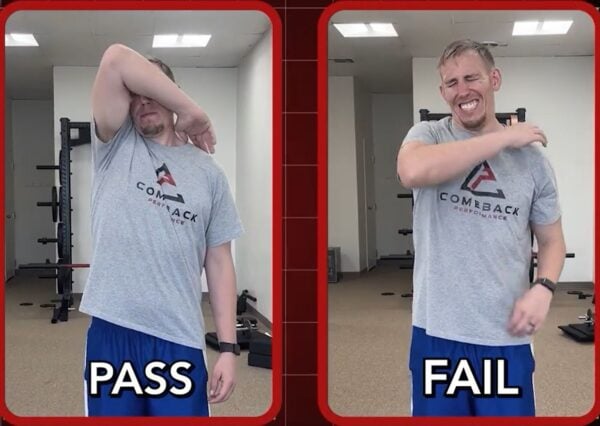
- Place the hand of your painful side flat on your opposite shoulder.
- Keep it there and lift your elbow straight up toward the ceiling.
- Sharp or pinching pain in the front of your shoulder is a positive sign.
- Remember how it feels.
Test 2: Hawkins-Kennedy Test
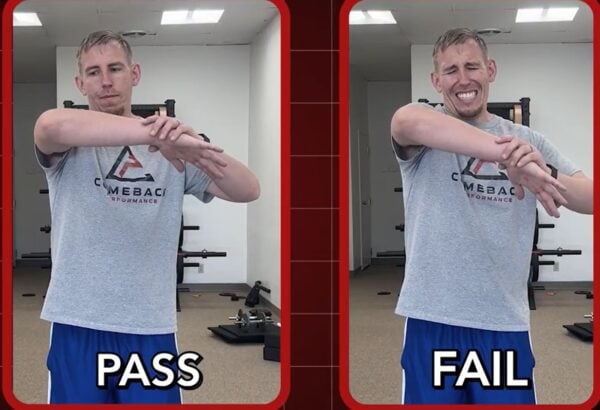
- Bring your arm straight out in front of you with your elbow bent at 90 degrees.
- Press your hand down, turning the shoulder inward.
- Pain in the front of the shoulder is a positive sign.
If either test lit you up, that’s impingement. Let’s address it now.
The 3 Exercises for Shoulder Impingement
Exercise 1: Wall Slide

Purpose: To restore your shoulder blade’s upward rotation, the foundation of pain-free movement.
Equipment Needed: A wall
How to Do It
- Stand facing the wall with one foot in front of the other.
- Place your hands on the wall at shoulder height, elbows hovering slightly off the surface.
- Push into the wall slightly and slide your arms upward, leaning your chest forward at the top.
- Let your shoulder blades move up and around your rib cage as your hands climb.
Sets: 2 sets of 10 reps
Tip: Go slow and stay controlled. Each rep should feel smoother than the last.
Exercise 2: Wall Angel

Purpose: To retrain your shoulder blade to tilt back and rotate outward as you raise your arms, keeping your shoulder out of the pinch zone.
Equipment Needed: A wall
How to Do It
- Stand with your back flat against the wall.
- Rotate your arms back so your hands come to the wall.
- Slide your arms up the wall slowly.
- Expect a pulling stretch in the front and a burn in the back as those muscles work.
Sets: 2 sets of 10 reps
Tip: Work only through the range your shoulder can handle right now, and it will keep improving.
Exercise 3: Banded Bear Sliders
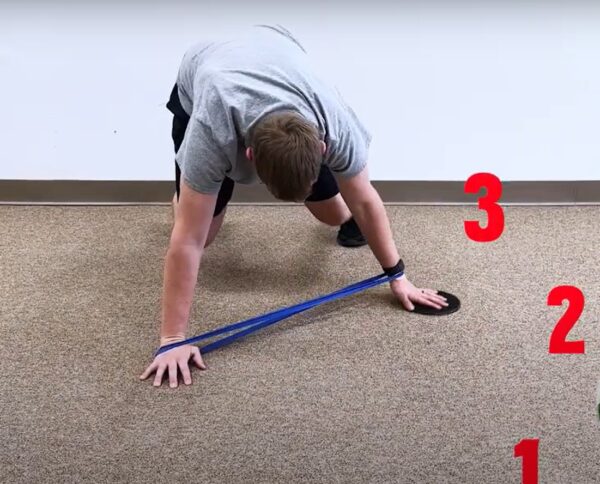
Purpose: To teach your shoulder blade and shoulder joint to work as a team.
Equipment Needed: Resistance band
How to Do It
- Get into a bear position – hands under your shoulders, knees under your hips.
- Place a band around your wrists.
- Lift your hips up.
- Slowly slide your hand in three different directions.
Sets: 2 sets of 5 slow slides in each of the three directions
Tip: This weight-bearing teamwork is the exact coordination that carries over to bench press, dips, and overhead pressing.
Retest and See the Difference
Now go back to both tests. Hand to opposite shoulder, elbow up. Then arm out in front, elbow bent, press down. How do they feel compared to the start? Any drop in pain or gain in range of motion means you’re on the right track. Even 10% better is proof that this is a mechanics problem, not a broken shoulder.
Your Next Step Toward a Pain-Free Shoulder
Stick with these three moves, but keep in mind shoulder impingement is a diagnosis. It doesn’t explain why your shoulder hurts. These exercises are a great starting point, but everyone’s root cause is different. If you’re dealing with shoulder impingement from bench press or any other lift, your “big five” areas need to be checked to find what’s lacking.
About the Author: Dr. Joey Seyforth


