
3 Exercises That Finally Take The Bicep Tendonitis Load Away
Bicep tendonitis is one of the most common diagnoses we see come back again and again once people return to the gym. A big reason is that there’s so much information out there: rest, stretching, injections, and cookie-cutter physical therapy exercises.
What traditional medicine often misses is that a one-size-fits-all approach is exactly what keeps people stuck. If you’ve been around that loop three or four times, it’s natural to start wondering if this shoulder pain will ever go away, or if it’s just something you have to live with.
In this article, you’ll learn the real root cause behind bicep tendonitis, one simple test to check it, and three exercises you can start today to stop bicep tendonitis flare-ups and get back in the gym.
Before you start the exercises, check if the bicep tendon is the area being irritated. This is called the Speed’s Test.

- Bring your painful arm straight out in front of you at about shoulder height. Keep your elbow straight and turn your palm up.
- Use your other hand to press down while the painful arm resists upward gently.
- Pay attention to whether you feel your familiar pain at the front of the shoulder, not just tiredness from holding your arm up.
- Rate that pain from 0 to 10 and remember the number.
If the test brings on your usual front-of-shoulder pain, it can be consistent with bicep tendon involvement. On its own, though, it doesn’t tell you the whole cause.
Quick Reference Guide
- Total Time: About 6 Minutes
- Targets: Shoulder Blade, Back of the Shoulder, Shoulder Joint, Core
- Goals: Reduce Front Shoulder Pain, Improve Shoulder Blade Movement, Build Shoulder Strength & Stability
3 Exercises to Stop Bicep Tendonitis Flare-Ups
Exercise 1: Banded Scap Angel
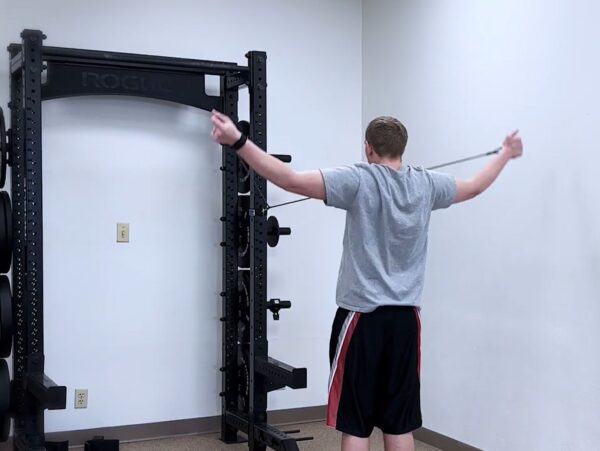
Purpose: To train your shoulder blade to rotate upward so the bicep tendon doesn’t get crushed in the space at the front of your shoulder.
Equipment Needed: Resistance Band, Anchor Point
How to Do It
- Anchor a resistance band in front of you at shoulder height. Hold it with both hands, elbows straight out in front of you.
- Pull the band straight back until your arms pass your torso.
- From there, move into an angel motion, bringing your arms out to the sides and up until your biceps finish next to your ears.
- Keep steady outward tension on the band the whole time.
Sets: 2 sets of 8–10 slow, controlled reps.
Tip: Keep your ribs down. Don’t let your lower back arch.
Exercise 2: Banded Extension Plus External Rotation

Purpose: To strengthen the back of your shoulder so your bicep doesn’t have to overwork.
Equipment Needed: Light Resistance Band
How to Do It
- Stand tall with a light band around your wrists behind your back, arms straight and hands by your hips.
- Pull the band apart to create tension and external rotation.
- Keeping that tension, move your shoulders slightly back into extension.
- Return to the start with control.
Sets: 2–3 sets of 8–10 reps.
Tip: You should feel this between and behind your shoulders, not in your neck.
Exercise 3: Kettlebell Pull-Through
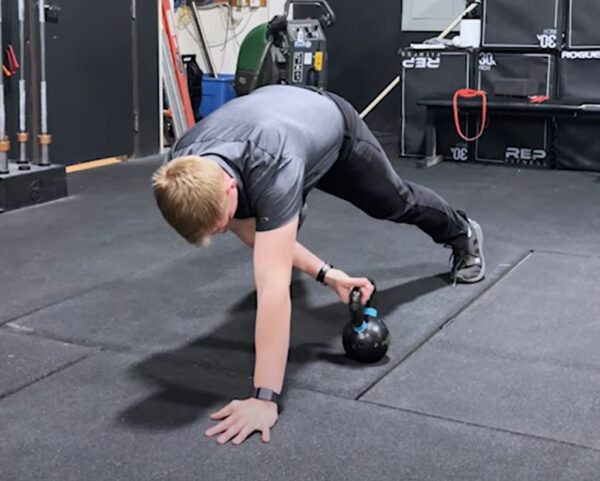
Purpose: To build core and shoulder stability together in the movement closest to what your shoulder does in the gym.
Equipment Needed: Kettlebell
How to Do It
- Get into a high plank with your hands on the floor and feet spread apart for balance.
- Place a kettlebell just outside one hand.
- Reach under your body with the opposite hand, grab the kettlebell, and pull it across to the other side.
- Alternate pulling to both sides.
Sets: 2 sets of 8 reps in each direction.
Tip: Don’t let your hips or lower back rock. Keep your whole trunk tight. The shoulder holding you up is doing real stabilizing work, and the tendon is finally off the hook.
Do these exercises daily for the first two weeks, then keep them as your warm-up before upper body days. While the pain settles, pull back on movements that load the front of the shoulder in a stretched position, like deep dips, deep bench, heavy front raises, and heavy curls. You don’t have to stop training, instead, you have to be smart while the tendon heals.
A quick note on pain: If any of these exercise movements brings back that familiar front-of-shoulder pain, ease off.
Building a Shoulder That Stays Pain-Free
These exercises are a great start, but on their own they likely won’t solve your bicep tendonitis long term. After working with thousands of shoulders, we’ve found that every shoulder has its own presentation and triggers, and responds differently to rehab. This ensures you can stop guessing and start a plan that actually fits your shoulder.
About the Author: Dr. Joey Seyforth


