
Rotator Cuff Tear on Your MRI? Read This Before You Book Surgery
Rotator cuff tears are far more common than you think. A huge number of people are walking around with a tear right now and have no idea. No pain or symptoms. They only find out when someone sends them for a scan.
So the tear on your MRI isn’t automatically the reason your shoulder hurts. If tears alone caused pain, all those people would be hurting too. Something else is going on, and we’ll cover exactly what that looks like. There are other ways to strengthen a torn rotator cuff and possibly avoid the operating room entirely.
Quick Reference Guide
- Frequency: 3–4 times per week.
- Targets: Rotator cuff (supraspinatus, infraspinatus, teres minor, subscapularis), shoulder blade, core
- Goals: To reduce shoulder pain, rebuild joint control and stability, and increase the load tolerance of your shoulders.
4 Exercises to Strengthen a Torn Rotator Cuff
Exercise 1 – Banded W Hold

Purpose: To build endurance in the back of the rotator cuff so the infraspinatus and teres minor can keep contributing to joint control.
Equipment Needed: Light resistance band
How to Do It:
- Hold a light resistance band with your palms up and elbows by your sides.
- Pull the band apart into a “W” shape.
- Hold, keeping your elbows tucked by your sides the entire time.
Sets: 5 sets of 10–15 second holds
Tip: Lessen the band tension and build it back up gradually if you feel any pain and discomfort.
Exercise 2 – Banded Kettlebell Upside Down Press
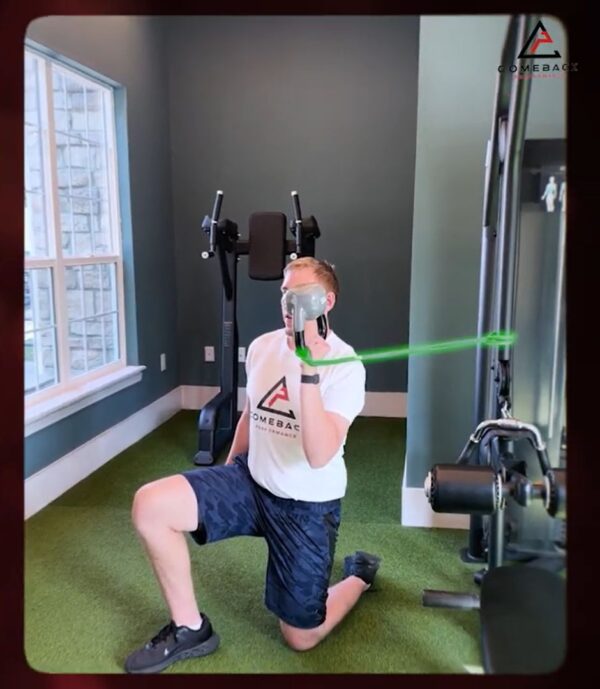
Purpose: To force your rotator cuff to make constant, small corrections as you press overhead.
Equipment Needed: Kettlebell and resistance band
How to Do It
- Wrap a band around the kettlebell so it pulls backward.
- Hold the kettlebell upside down (bottom up).
- Press slowly overhead without losing your shoulder position.
Sets: 3 sets of 8 reps
Tip: If it’s too hard, use a lighter kettlebell or do a regular shoulder press instead.
Exercise 3: Banded Scaption
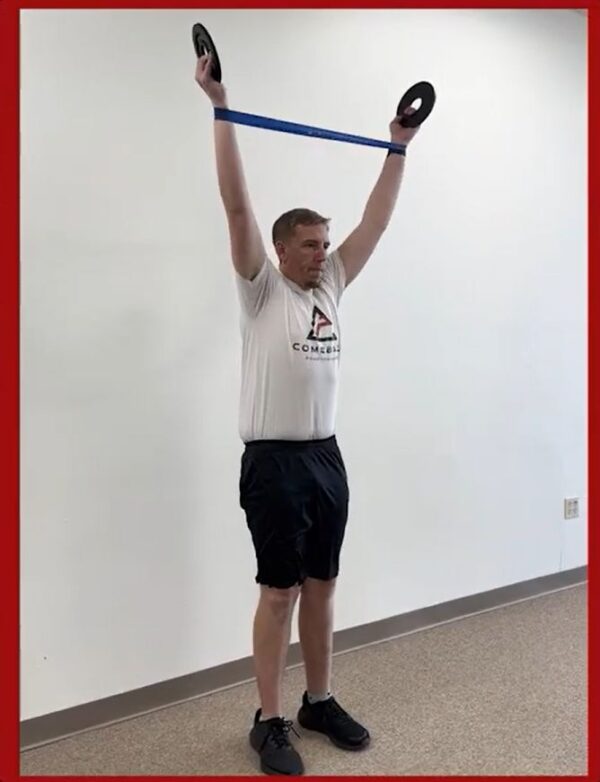
Purpose: Trains your rotator cuff and shoulder blade together as your arm rises in roughly a 45-degree plane.
Equipment Needed: Light resistance band or light weights
How to Do It
- Place a light band around your wrists and keep gentle outward tension on it.
- Hold light weights in your hands.
- Raise your arms through the 45-degree plane with slow, controlled movement.
- Control the motion all the way back down.
Sets: 2 sets of 10 reps
Tip: Only lift as high as you can, and don’t force your way through a painful range.
Exercise 4 – Shoulder Taps
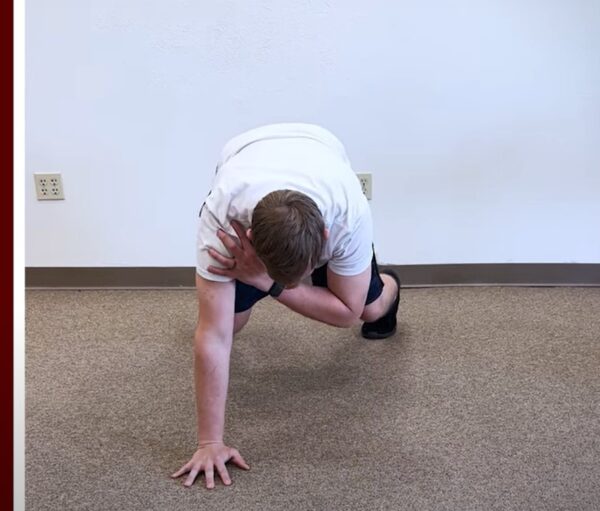
Purpose: To bring everything together with dynamic rotator cuff activation.
Equipment Needed: None (stairs or a bench optional)
How to Do It:
- Get into a push-up plank position.
- Tap one hand to the opposite shoulder, then switch sides.
- Keep your torso and hips completely stable without letting them sway.
Sets: 3 sets of 8–12 taps per side
Tip: If a floor plank is too difficult, put your hands on a set of stairs or a bench and do the same movement.
When You Should See a Specialist
If you suddenly can’t control lowering your arm from overhead, have major functional weakness, or keep dropping things throughout the day, get an in-person orthopedic assessment and discuss your options. That doesn’t automatically mean surgery. But it’s not something to solve with an online routine alone.
Lasting Fixes For Your Shoulder
Strengthening your rotator cuff takes time. Getting the right reps and the right dose of exercise is what builds the right movements in the right way. Stick with this sequence three to four times a week and progress it based on how your shoulder responds. That said, after working with thousands of shoulders, one thing is clear – each one needs a specific plan to get long-term results. If you’re ready to fix your shoulder pain finally, our one-on-one online coaching and rehab is built for exactly that.
About the Author: Dr. Joey Seyforth


