
Bicep Tendonitis That Won’t Quit? Test It, Then Try These 3 Exercises
You’ve probably done everything you were told to do to get rid of the nagging pain right in the front of your shoulder. You stretched it. You rested it. Maybe you even had injections or went through physical therapy for shoulder pain. And it worked… for a while. Then you went back to the gym, and it flared right back up.
Here’s what most people never hear: bicep tendonitis is not the problem. It’s the symptom. Until you find what’s actually driving it, it will keep coming back every time you train.
You can start figuring this out today. Below, you’ll learn a quick 10-second Speed’s test for bicep tendonitis, what’s really behind your pain, and three exercises to start getting relief right away.
And yes, this works for real lifters. One of our clients, Arman, had chronic bicep tendonitis and couldn’t do dips for years. After we addressed the real root cause, he was finally able to do them again, and for him, that was proof he was heading in the right direction.
Quick Reference Guide
- Total Time: Few minutes.
- Targets: Neck, Thoracic Spine, Shoulder Blade, Shoulder Joint, Median Nerve
- Goals – To reduce Front-of-Shoulder Pain, Offload the Bicep Tendon, and Improve Shoulder Mechanics.
Start With Speed’s Test for Bicep Tendonitis

Before you do anything, confirm what you’re dealing with. This takes about 10 seconds.
- Hold your arm straight out in front of you with your thumb pointing up toward the ceiling.
- Keep your elbow locked.
- Use your other hand to press down on your wrist while you resist the pressure.
If you feel pain at the front of your shoulder, right where the bicep tendon attaches, that’s a positive sign for bicep tendonitis. And if that lit you up, don’t panic. That’s exactly what we’re addressing, and you’ll retest it at the end.
The 3 Exercises to Offload Your Bicep Tendon
Exercise 1: Median Nerve Glide

Purpose: To help the median nerve glide freely from your neck down to your fingers.
Equipment Needed: None
How to Do It
- Start in a “teapot” position with your fingers touching your shoulder.
- Extend your elbow, wrist, and fingers down toward the ground.
- At the same time, side-bend your neck toward the opposite ear.
- Return to the start and repeat. Whenever your hand moves, your neck moves too.
Sets: 2 sets of 10 reps on both shoulders.
Tip: You might feel tingling, tightness, shaking, or pulling. Those are normal, so don’t be frightened.
Exercise 2: 3-Month Prone Hold
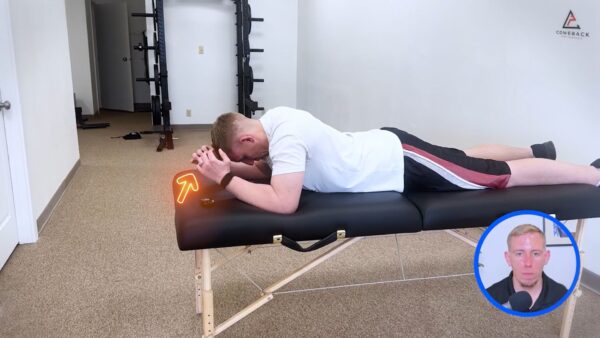
Purpose: To strengthen the muscles that keep your shoulder centered and your bicep tendon offloaded.
Equipment Needed: None
How to Do It
- Lie flat on your stomach with your elbows at ear level.
- Pull your shoulder blades down and back while keeping your elbows on the floor.
- Lift your hands slightly off the ground, as if holding a soccer ball between them, and tuck your chin.
- Press into the ground and slowly lift your chest, keeping your chin tucked the whole time.
Sets: 2-3 holds of 20-30 seconds.
Tip: Fair warning, this one is spicy in a good way. You should feel it in your lower traps, rotator cuff, and mid-back.
Exercise 3: Banded Extension with External Rotation

Purpose – To teach your shoulder to sit back and down instead of forward, so your bicep tendon can stop working overtime.
Equipment Needed: Light Resistance Band.
How to Do It
- Place a light band around your wrists behind your back, arms straight and hands near your hips.
- Pull the band apart slightly to create external rotation tension.
- Keeping that tension, move your shoulders slightly back into extension.
- Return to the start with control.
Sets: 2-3 sets of 8-10 reps.
Tip: You should feel this between and behind your shoulders, not in your neck. No shrugging; keep your shoulders away from your ears, and move smoothly with no jerking.
Building a Shoulder That Stays Pain-Free
Stick with these exercises consistently, and always work within what your shoulder can tolerate. If the pain gets worse instead of better, stop and get it checked.
But keep in mind that these three exercises are a great starting point, not the complete solution. Everyone’s root cause is different. If Speed’s test for bicep tendonitis still lights you up, the only way to fix it for good is to find out what is driving your pain and build a plan around it.
About the Author: Dr. Joey Seyforth


